
TAFM → The Move → Terrain-Control Moves → Category Control → No True Scotsman
What is a “No True Scotsman1” Fallacy
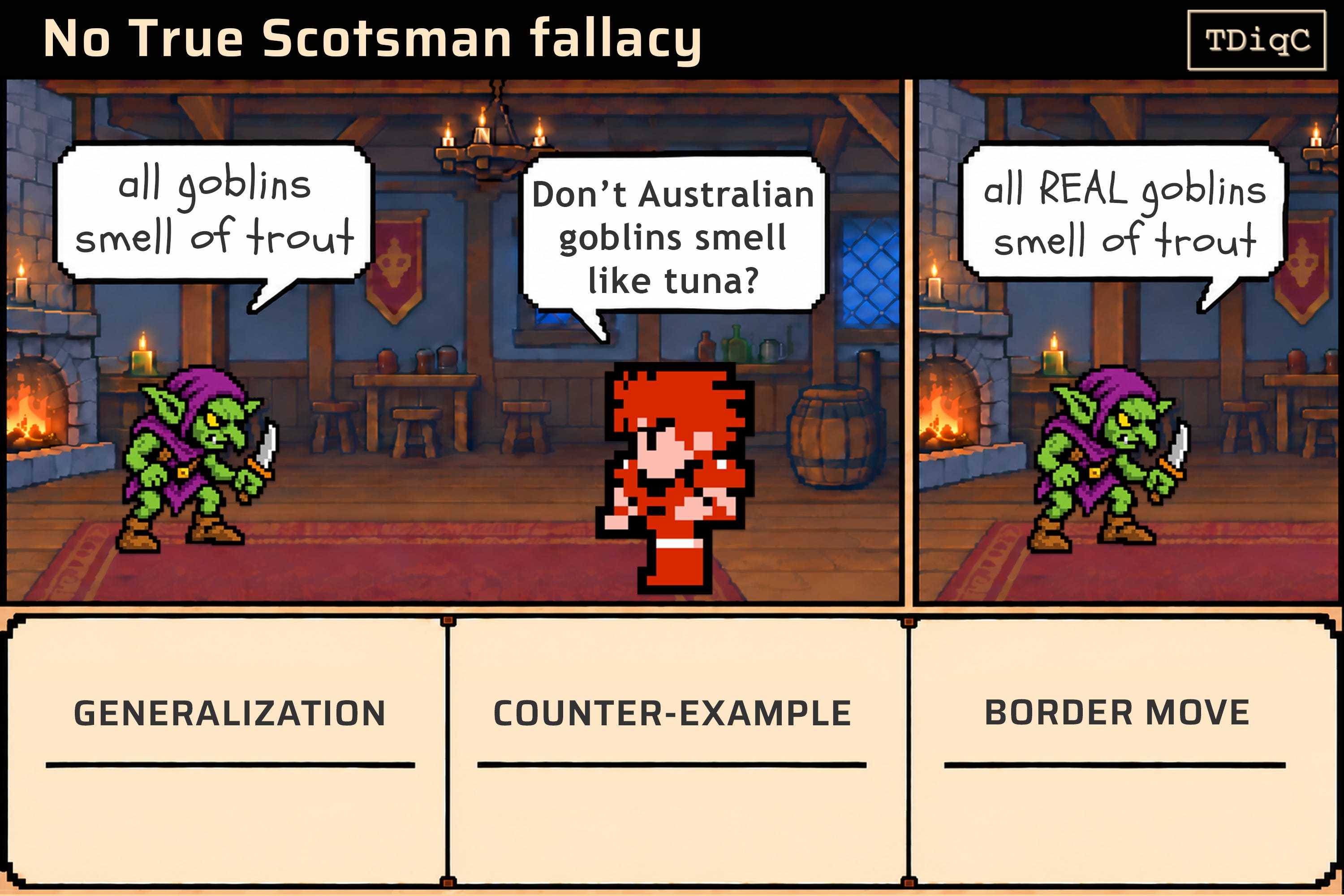
goblin (Claimer): “all goblins smell of trout”
Fighter (Challenger): “Don’t Australian goblins smell like tuna?”
goblin: “all REAL goblins smell of trout”
Category: goblins
Property: smell like trout
Counter-example: An Australian goblin that smells like tuna
Typically, in this document:
X = category
Y = the property asserted in the original generalization
A = the counter-example case
Skip to Table of Contents
What’s Happening Here?
The claim started out being about goblins.
Then an inconvenient goblin appeared.
At this point, the claimer can either:
1) Defend the original claim:
(usually NOT a No True Scotsman)
Dispute that Australian goblins exist;
Dispute that they smell like tuna;
Retract or weaken “all”;
2) Modify the category membership to exclude the inconvenient counter-example:
(a possible No True Scotsman)
The category border moves only after the counter-example appears.
The original empirical claim survives only because the population being described has changed.
*) Important interpretive points:
In the cartoon above, the word REAL is evidence of the maneuver, but not proof of it.
Other commonly used “purity-words” that hint at this maneuver are “true”, “genuine”, “authentic”, “proper”.
The fallacy is not the purity-word itself, and legitimate category updates can contain them.
More nuanced versions of a No True Scotsman may not have any purity-words in them at all.
The important question is whether the newly narrowed category has an independent basis, or if it was an added ad hoc rescue.
Definition
Ad hoc: (“to/toward this”): An on-the-spot fix to save a claim from a counter-example. The new reason is tailored to rescue the original claim and isn’t part of a consistent rule.
This is the No True Scotsman maneuver.
The counter-example is not answered — it’s excluded from the category in order to save the original claim.
All goblins smell of trout.
became:
All REAL goblins smell of trout.
A No True Scotsman is about the border move: changing the membership rules after a counter-example arrives, without an independent reason for the new boundary.
Table of Contents
Core Definition
A No True Scotsman is a category control maneuver that protects a generalization from a counter-example by retroactively narrowing the category — without independent justification — so the counter-example no longer counts.
The important phrase here is without independent justification.
The cleanest form is:
Generalization: All X’s are Y
Counter-example: this X is not Y
Rescue: then this is not a true X
A No True Scotsman is also referred to as an Appeal to Purity fallacy.
False-Positive Check:
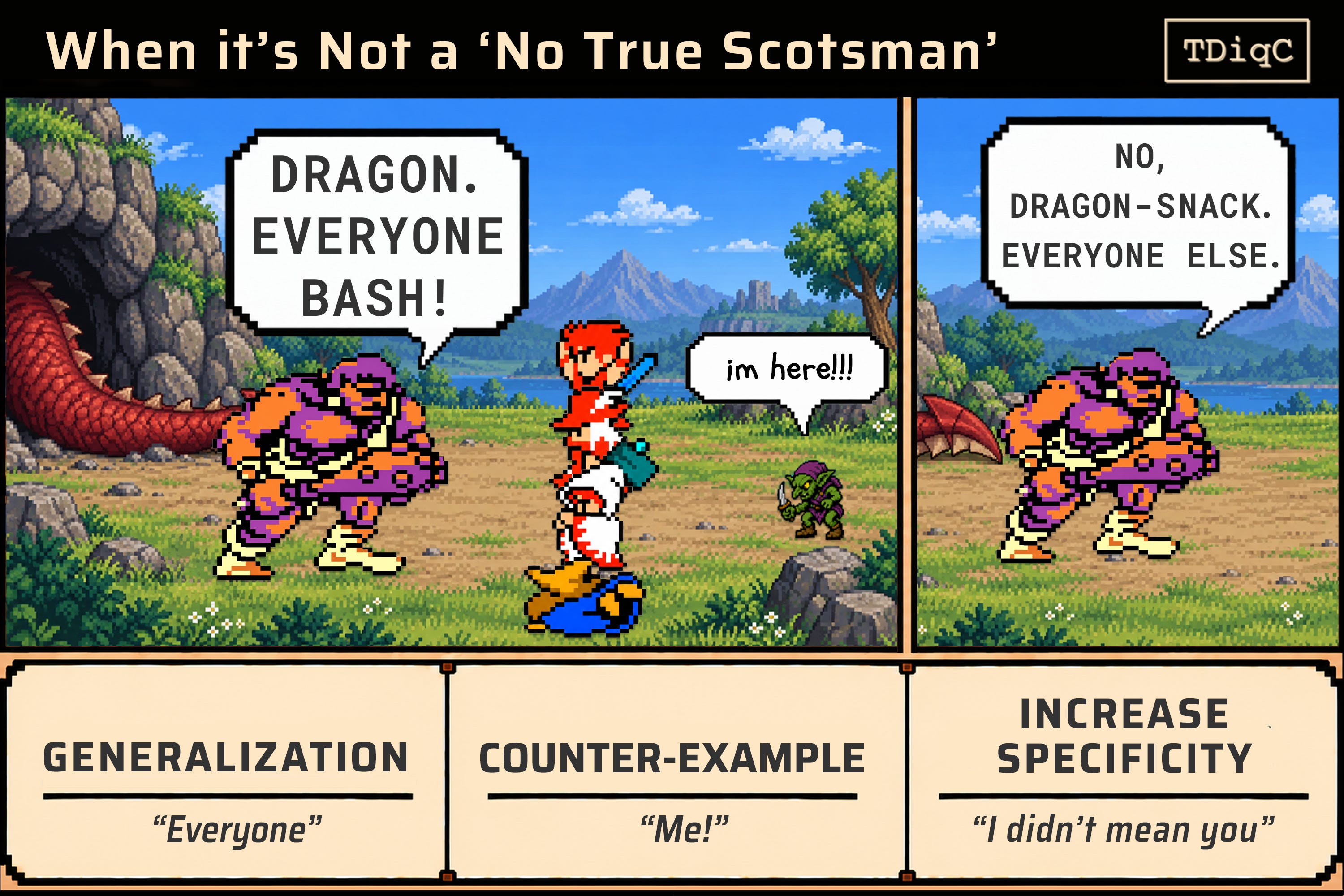
When It’s NOT a No True Scotsman
A No True Scotsman starts with an all-or-nothing generalization, because it involves making an absolute claim. ALL X’s are Y.
The following are examples of phrases which are inherently NOT part of a No True Scotsman fallacy:
“MOST X’s are Y.”
“X TENDS to correlate with Y.”
Sometimes a counter-example really is a misclassification.
Sometimes a category genuinely has stricter boundaries than were initially stated. This can be due to oversight, or simply because pointing out every edge case and caveat would take too long and make a conversation too cumbersome.
Sometimes a counter-example exposes a real ambiguity and forces defining a term more carefully.
How can you tell if someone’s rejection of a counter-example is legitimate or a No True Scotsman? Well, you usually can’t. Not 100%. Sometimes the person employing the maneuver knows they are being unfair and are just forcing their desired interpretation of the category in question. Sometimes they aren’t aware they’re even performing the maneuver. With enough evidence, however, it can become a likely inference (diagnosis).
Suspect a No True Scotsman move when a new boundary looks less like clarification and more like an evidence-removal system.
Temporal clues
Criterion existed beforehand → evidence against a No True Scotsman;
Criterion first appears under pressure → evidence for a No True Scotsman;
Caution: Neither timing condition is conclusive by itself.
How to Build a No True Scotsman Fallacy
Canonical five-stage mechanism
General claim Y about X
Universal or absolute claim about X
You: “All X are Y.”
Counter-example
Case A meets the criteria for X
But A lacks Y
Them: “Here is A. It’s an X that is not Y.”
Category boundary is narrowed retroactively
X becomes X1
X1 is narrower than X
A doesn’t get to countYou: “That A is not a real X, real X’s are X1’s.”
Counter-example is expelled
A is an X under the original category, but is NOT an X1
(A is pushed out through reclassification rather than rebuttal)You: “A is not an X1, so it’s not a real X. Your A is disqualified.”
Original generalization appears to survive
Continues as though X was X1 the whole time
You: “All X are Y”
Purity-word forms
“No real X would…”
“No true X could…”
“A genuine X…”
“A proper X would never…”
“That isn’t what a real X is.”
“That faction doesn’t really belong.”
“That’s not what X really stands for.”
“They were never really one of us.”
Non purity-word forms
The maneuver does not require the literal words “real”, “true”, “genuine”, or “authentic”. These are examples of other ways a No True Scotsman can be encountered in the wild:
“By definition, X wouldn’t do that.”
“You’re using the term incorrectly.”
“They may call themselves X, but…”
“They only call themselves X.”
“X in name only.”
“Anyone who does Y has stopped being X.”
Treating an inconvenient member as an impostor solely because they violate the generalization.
Caution: Any of these examples could be legitimate reasons. Just because someone says them, it doesn’t mean that they’re employing a No True Scotsman fallacy.
How to Repair a No True Scotsman
If the claimer responds to a counter-example with:
“My original claim was too broad”
“Your counter-example defeats the generalization”
“You interpreted my generalization more absolutely than I intended it.”
This is belief revision or semantic clarification, NOT No True Scotsman.
If the generalization is:
“Birds fly”, and the response is:
“Penguins don’t”, then
Belief revision = “Right — I didn’t realize penguins were real birds”
Semantic clarification = “Right — I meant birds generally, not every bird”
No True Scotsman = “Penguins aren’t real birds”
Examples of a repaired/avoided No True Scotsman, when the revision or clarification:
Explains other cases:
Generalization: “All metals sink in water.”
Counter-example: “Hollow metal boats float.”
Revision: “Ah, well yes, anything that has a lower overall density than water will float.”
Generates additional expectations;
Generalization: “Male lions have manes.”
Counter-example: “male cubs don’t.”
Revision: “okay, so I guess the mane must develop as the males mature.”
Identifies a distinction that can be investigated independently:
Generalization: “Every doctor can point to your spleen.”
Counter-example: “I’m a doctor of archaeology and I don’t even know how many spleens we have.”
Clarification: “Well, sure. Every medical doctor can point to a spleen.”
How to respond to a No True Scotsman
To resolve this maneuver:
The new boundary has to pass as a legitimate update — rather than an ad hoc reaction to the counter-example.
Ask for the membership requirements of the original generalization, and the independent basis for the border-move.
Diagnostic test:
Ask: “Does the counter-example actually belong to the original category?"
Ask: “Why should it now be excluded?”
If the only justification is nothing more substantial than:
“Your X can’t be an X because X’s don’t do Y,”
the ad hoc rescue is circular reasoning.
Why It Matters
The obvious problem with a No True Scotsman is that it lets bad generalizations survive the very evidence they were supposed to answer to.
That is the true risk — instead of the claimer taking on the burden of proving their claim against the challenger’s counter-example, the evidence is just defined out of existence.
A claim that looked empirical can quietly become definitional.
At first:
“X’s don’t do Y.”
Is something we can investigate by looking at X.
“Is it true that X’s DON’T ever Y / X’s AREN’T ever Y?”
But:
If every "X who DOES Y / X who IS Y” is automatically declared “not a real X”, then no observation can ever count against the generalization.
X has become impervious to inspection.
This matters because it can:
Preserve stereotypes despite counter-examples
Erase inconvenient diversity within groups
Transform embarrassing members into non-members
Change an evidential dispute into an authenticity dispute
Make a claim unduly resistant to falsification.
Once the discussion moves from:
“Do X’s actually have this property?”
to:
“Does this person deserve to count as an X?”
The first question can disappear entirely.
Chorus: “Hens love roosters, geese love ganders, everyone else loves Ned Flanders!”
Homer: “Not me!”
Chorus: “Everyone who counts loves Ned Flanders!”
And just like that, the conversation becomes about category membership.
The challenger is now forced to defend not only their counter-example, but also the counter-example’s membership in X.
Why It Works
We confuse atypical with unreal
Someone or thing can be a terrible example of an X and still be an X:
A dishonest scientist is still a scientist
A terrible parent is still a parent
An incompetent lawyer is still a lawyer
Purifying the category can make it easy to slide from:
“That is not what a good X should be”
to:
“That is not an X”
But keep your wits about you — those are different claims.
“We like OUR groups clean.”
(Ingroup protection)
If a group matters to your identity, then an ugly counter-example can feel like an accusation against the group itself… or even against you.
Watch for emotional reactions that may colour your thinking.
— This reaction can significantly intensify with a public audience.
Conceding:
“Yes, that person belongs to us, and they behaved badly”
May feel like surrender.
Expelling them can signal loyalty over judgement:
“That is not what we are.”
Sometimes that is a moral aspiration.
Sometimes it’s self-protection or public relations.
Expelling the offender “solves” two problems at once:
The generalization survives;
The group’s moral image survives.
This can make a No True Scotsman especially tempting in political, religious, ideological, professional, relational, and subcultural disputes.
THEIR groups are dirty!
(Outgroup hostility)
A No True Scotsman can be used to protect hostile claims about an outgroup.
Suppose YOU claim:
“All members of X are irrational.”
- Then THEY present a perfectly rational member of X.
You respond:
“They aren’t really X.”
Same machine. Different emotional direction.
Purity-words can be interpreted differently
“Real X” can mean:
literally a member of X
a typical X
a good X
a model X
a loyal X
an authentic X
Not only can the claimer and challenger have different understandings of a “Real X”, but meaning can slide around during a conversation without anyone announcing the switch.
Ordinary language is already fuzzy
We routinely say things like:
“Cats hate water”
But some cats love to swim.
“Lawyers go to court”
But many contract lawyers never do.
“Fans support the team”
If the star player is out with an injury, even some die-hard fans may bet against “their team”.
In order to have an actual conversation, generalizations can often tolerate exceptions. But this flexibility introduces some uncertainty.
The speaker may have meant:
All
Most
Typically
Ideally
By definition
This semantic fog is where No True Scotsman thrives.
Caution:
None of this requires dishonesty.
Someone can sincerely discover, only after an exception is pointed out, that their concept of “real X” was more of an ideal than they realized.
But sincerity does not make the reasoning sound.
Essentialist intuitions
People often treat categories—especially social identities—as though they have an underlying essence, rather than being a broad bucket that many different individuals are loosely placed into.
Then, behaviour that is inconsistent with the imagined essence can feel like evidence against membership — rather than evidence that the category is more diverse than they thought.
Common Escalation
Once the first exclusion is challenged, the border may grow legs.
The pattern can become:
Counter-example is excluded
Challenger asks why it doesn’t count
Claimer adds new purity requirements
The category becomes progressively narrower
New counter-examples are expelled using new criteria
Debate migrates entirely from the original generalization into a full-scale audit of member authenticity
Eventually, the logic may become perfectly circular:
A) “If you have Y, you are a true X”
B) “If you do NOT have Y, you are NOT a true X”
C) “Therefore all true X’s have Y. Why? Because A) and B) that’s why.”
The generalization is completely protected by building the category around the conclusion.
The escalation can also spill into neighbouring moves.
A membership rule may start behaving like a moving goalpost. An awkward member may be recast as a fraud or infiltrator. The entire conversation may disappear into an endless dispute over who is authentic enough to count.
Possible escalations into other argument maneuvers
These are not necessarily part of a No True Scotsman maneuver; however, they may be where such an argument ends up:
Goalpost moving: the standards for membership keep changing.
Bad-faith accusation: counter-example is unjustly declared “fake”, “deceptive”, or is accused of being an infiltrator, an impostor.
Semantic takeover: the original argument disappears and now the fight is about labels.
Self-Audit / The “Am I Being Fair” Tool
YOU just made a claim.
“All X’s have the property Y”, you say.
THEY respond with “But here is an X that does NOT have the property Y”
So, what now?
Test your justifications. Is it fair that you are not allowing the proposed member to be counted in your generalization?
Ask yourself:
Did I have this membership rule before the counter-example appeared?
Did I already mean “not that counter-example”, but just left it out for convenience/brevity, or is it my first time considering it?
How certain am I that it’s a non-X and not just a bad X?
Am I moving from a membership rule to a judgment of moral worth?
If one of my favourite members in the X category suddenly lost the property Y, would I suddenly revoke their membership too?
Can I state the membership rule without referring to the counter-example that threatens my generalization?
Have I actually revised my claim, or am I pretending nothing changed?
Related Concepts
Definition Retreat: A retreat by changing the meaning/category scope, rather than answering evidence. A No True Scotsman does this by excluding counter-examples that threaten a category generalization.
Unfalsifiability: A claim that is impossible to disprove. In a No True Scotsman, dismissing every possible counter-example makes the claim unfalsifiable because no possible observation can count against it.
Moving the Goalposts: When the requested evidence is provided, the needed evidence changes. With a No True Scotsman, when evidence is provided in the form of a counter-example, the counter-example is excluded from being considered a member of the category, group, or population being examined.
Motte-and-Bailey: A retreat from a stronger claim to a weaker one when encountering pushback. While not the same maneuver as a No True Scotsman, the two can be combined or are sometimes found in the same argument. They are used together in the same argument more often by disingenuous actors, but that is not a rule, and not absolute proof of the arguer’s insincerity.
Ad Hoc Rescue: A broader family of after-the-fact claim protection. It protects a claim by introducing a new modification that affects evidence against it — either diminishing the strength of the evidence, or disqualifying it altogether. A No True Scotsman defends a threatened generalization by altering what counts as category membership. If a counter-example does not count as a member of the subject of the generalization, then the evidence can be dismissed entirely.
Continue through the Manual
↑ Browse the Argument Field Manual
⌂ Visit The Triple-Digit IQ Club
Footnotes
Origin / History
The “No True Scotsman” fallacy was coined by the philosopher Antony Flew↗︎ in his 1966 book “God & Philosophy.” To show how people often defend generalizations, Flew presents the illustrative example (not in these exact words):
Angus: “No Scotsman puts sugar on their porridge.”
goblin: “Dougal is a Scotsman, and he puts sugar on his porridge.”
Angus: “No TRUE Scotsman puts sugar on their porridge!”