
TAFM → The Move → Defensive Moves → Defensive Retreats Guide → Motte-and-Bailey
What is a “Motte-and-Bailey”
Subscribe to The Triple-Digit IQ Club
⠀
Table of Contents
⠀
Core Definition
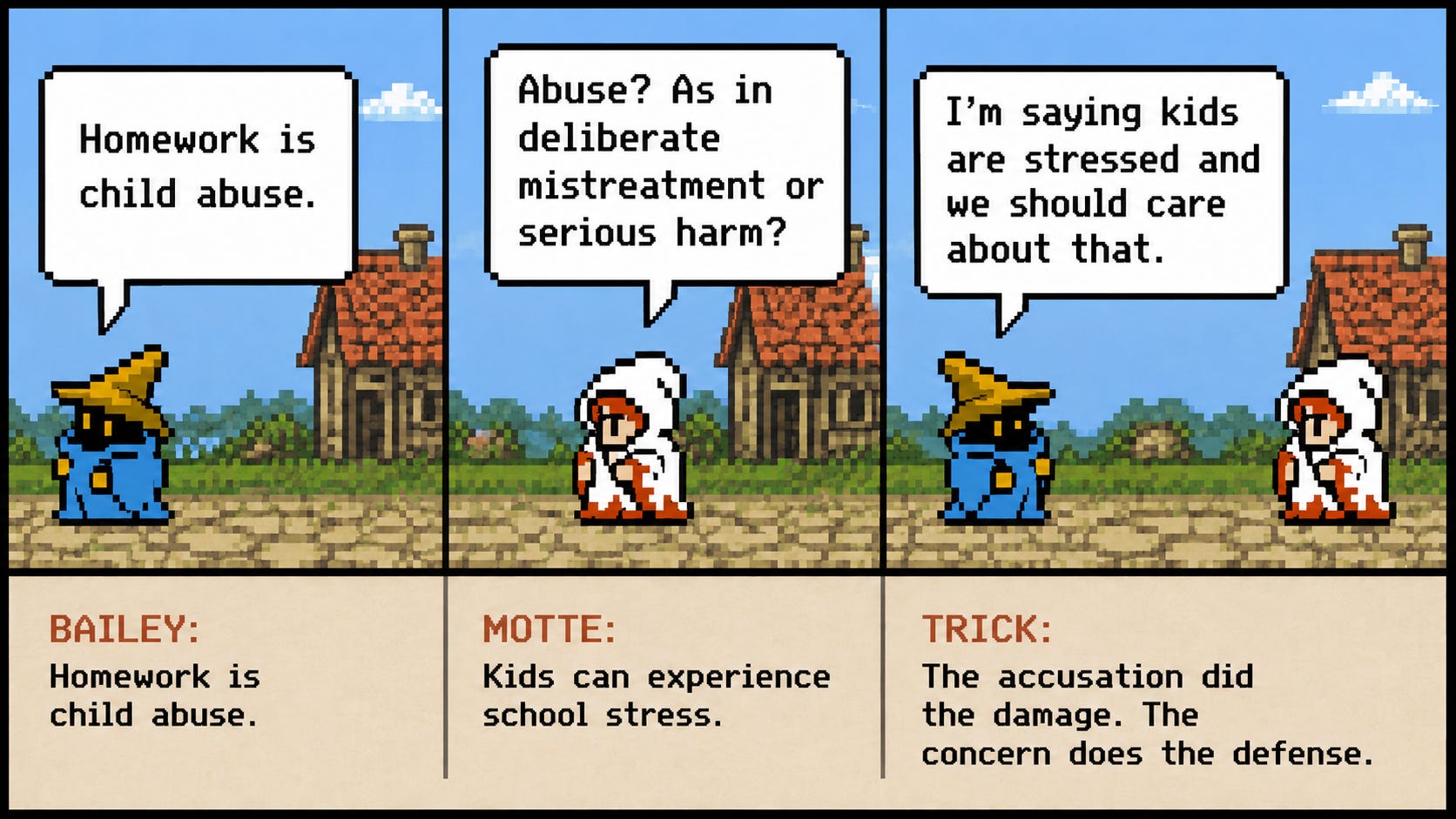
A motte-and-bailey is advancing a bold claim, then retreating to a safer version when challenged.
⠀
What’s Happening Here?
The person advances a bold, aggressive, territory-grabbing claim. When challenged, they retreat to a safer, weaker, more defensible claim. Then, once the danger passes, the bold version mysteriously reappears wearing fresh lipstick and pretending nothing happened.
The bailey gets the applause.
The motte gets the defense.⠀
⠀
You’ll recognize this when…
The claim changes altitude under pressure. The first version sounds dramatic, expansive, and consequential. The defended version sounds obvious enough that disagreeing with it makes you look like you eat crayons recreationally.
The move depends on treating the safe version as if it proves the bold version.
⠀
Why it matters:
Motte-and-bailey arguments let bad claims borrow the credibility of good ones. They expand aggressively, defend modestly, and then expand again once everyone gets tired.
This makes debates slippery. You think you are challenging “X is violence,” and suddenly you are being asked why you deny that words have effects. Nice little claim you had there. Shame if someone replaced it mid-sentence.
⠀
Related concepts:
Motte Retreat, Definition Retreat, Strategic Vagueness, Claim Compression Check, Standard Check
⠀
Common disguise:
“That’s obviously what I meant.”
⠀
Common escalation:
The retreat is treated as clarification, and your objection to the original claim is treated as hysteria.
⠀
Repair move:
Ask: “Which claim are we evaluating: the bold one you used, or the safe one you are defending now?”