

— Matt
Restated in English:
If it’s about “survival of the fittest” and we evolved from African Americans into other Americans, what about the African Americans that are still alive today?
They say:
There are no stupid questions,
…only stupid questioners.
They shouldn’t say that anymore.
I would like to scoop out Matt’s brain and take a looksee at it. Must be fascinating the way the gears turn and the intricate spring system, the empty wheel—the hamster long since dead.
But, I cannot answer “If Americans came from African Americans, why are there still African Americans”. On that question specifically, I am defeated. It’s too dumb to answer. So, I’m going to fix his question first, and then show that even when it’s fixed, it’s broken.
There is a little rotten seed of a good kernel of a question deep inside Matt’s model, and I’d like to dig it out and look at it, because it involves some super interesting history about human skin.
There is, inside Matt’s malformed question, a real one trying to get out. It is also dumb.
The root of this question, is the old:
“If humans came from monkeys, why are there still monkeys?”
Now, if you gave 1-million monkeys with 1-million cases of head-trauma 1-million typewriters, one of them would eventually type out the stupidest form of the question above:
“If white people came from black people, why are there still black people?”
That right there ⬆️ is the maximally-ignorant way to express this question.
Matt, impossibly, asked a maximalier one.
Trying to answer Matt’s actual question would be like trying to untie a thought-knot, and logic is hand-lubricant.
So, I’m going to answer the less stupid one… the stupidest one… because a one in a million monkey with brain damage isn’t the only one who can outsmart Matt on evolutionary science.
Matt’s Folly
I would like to understand Matt’s mindset. What model would you need to believe, for you to ask Matt’s question—without blushing yourself into the infrared in an attempt to become invisible to the human eye?
While his question makes my brain want to extrude out my ears and fling itself into traffic, it doesn’t actually sound stupid to him. People rarely hold beliefs they think are dumb. I have a few, but I only believe them with a bunch of tongues in my cheek.
Matt is not asking a stupid question inside his model of evolution. The problem is that his model allows him to ask nonsensical questions without realizing they are nonsensical. Like an alien from another dimension arriving in ours, experiencing colour for the first time, and asking what kind of fish is best for cleaning blue.
That is the problem. Matt’s model is broken. He doesn’t need to be taught “what evolution says” about his question. He needs a working model of evolution — so he can answer this question for himself.
Science isn’t trivia — it’s a verb.
Matt’s fundamental folly is that he believes one species “beats” another species, then supplants it—takes the older form’s place because it was fitter. He understands evolution as a ladder. But a ladder is a man-made construct. Nature, quite famously, doesn’t make man-made constructs.
Nature doesn’t do ladders — it does trees.
He believes that all life on Earth is striving to graduate into evolution’s end goal: white Americans. This is a teleological error1 — treating evolution as if it is working toward a goal.
I would hate to think this has to actually be said, but:
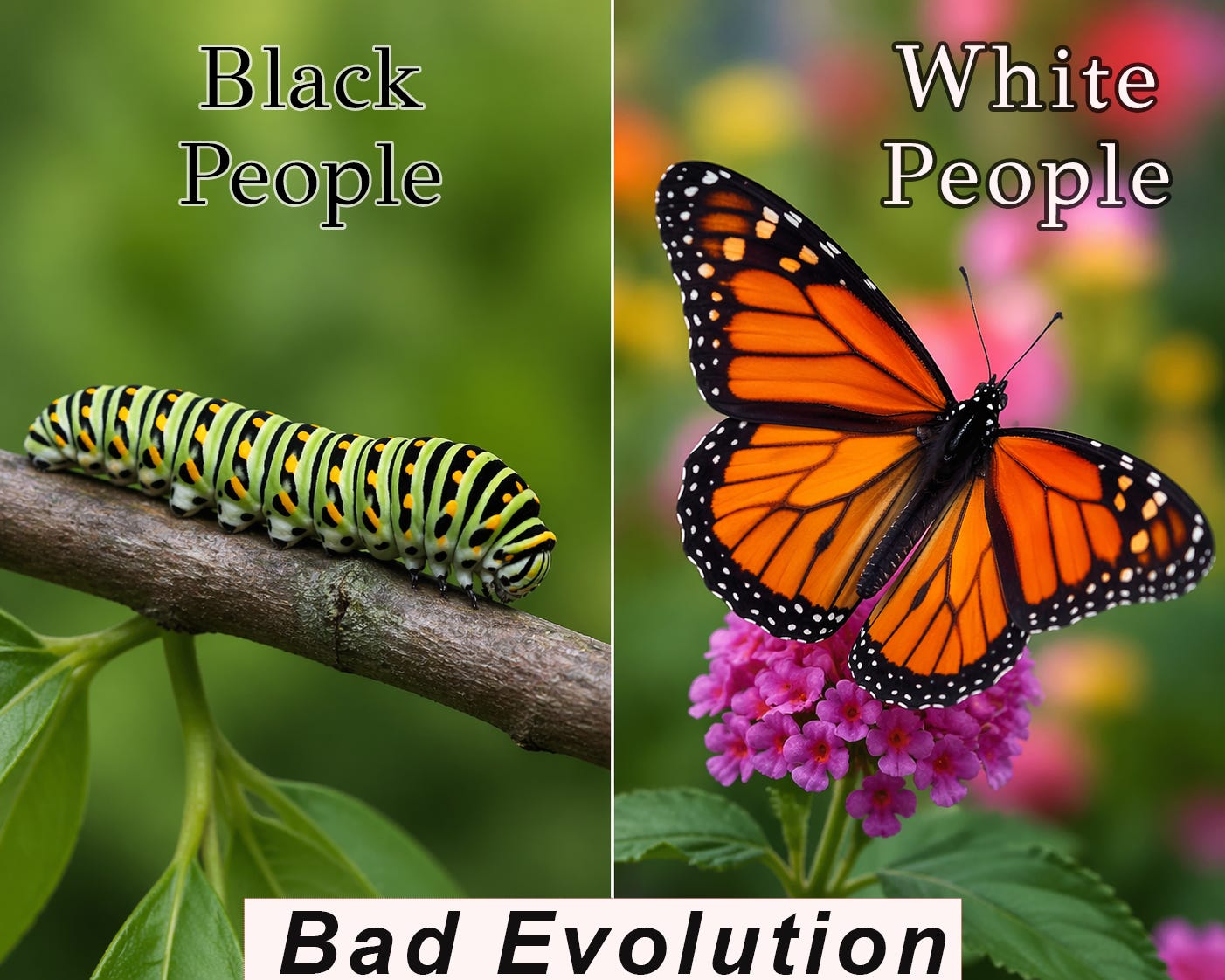
White people are not evolutionarily grown-up black people.
TODAY’S white people and TODAY’S black people had the same grand-pappies, if you go back a few hundred dozen levels of grandparents. Their skin was black — in colour, not category — but that doesn’t mean that dark-skinned or African people today are any “closer” to that black ancestor of ours ~50 thousand years ago. Everybody today is just as far removed from our shared ancestors as everybody else. Some of us homo-saps just had our recent line of ancestors undergo a series of skin adaptations to suit their environment better.
Do English People Come From German People?
Nope. But language makes Matt’s ladder vs tree branching mistake easier to see.
English and German are related languages. They’re cousin languages. Once upon a time, people in an area spoke a language that had no name. Today, we call that name Flibbityfloop2. Some of those prehistoric Flibbityfloopic speakers sailed to an island, and began a civilization.
Over time, slowly, steadily, sometimes in bursts, both the island and mainland groups’ use of Flibbityfloop changed. The islanders needed words for things like tides, jellyfish, and “that hole on the top of whales they spit water from”. And the mainlanders needed words for mountain passes, wagon ruts, and the clan of horse-men who came from the East and ruined everyone’s day.
After 2,500 years of this, the people who stayed on the mainland are those who speak German today. The ones who went to the island are speaking English today.
English didn’t “come from” German. English and German share a common ancestor, called Flibbityfloop. But as can be deduced, even if they were not cousin languages, there would be no need for old Flibbityfloop to become an “extinct” language for English or German to exist today. Languages are not static, even when they stay the same language. (think: “six-seven”)
This is the evolutionary point. White people didn’t “come from” the black people of today. Today’s white people and today’s black people share older ancestors. One modern branch did not climb out of the other and leave it behind3.
Survival of the Rizziest:
“Survival of the fittest” is not the entire slogan. Its incompleteness leads a lot of people to an unclear understanding of what actually drives the process of evolution. The full slogan should be “survival of those who are the fittest for the environments they live in, and have more children than their peers who themselves survive long enough to reproduce.” In the context of evolution, you win at life if you have grandkids.
That means “fittest” cannot be answered in the abstract. Fittest where? Under what sun? Eating what food? Facing what risks? A trait that helps one population survive and reproduce in one environment can become a liability in another.
Which brings us to skin.
Why Be Black?
Two reasons. Vitamins B9, and D.
Funnily enough, they’re the same reasons for being white.
Our big beautiful yellow ball of Superman-food in the sky feels wonderful on the skin, but it’s actually a killer radiation cannon. Specifically the ultra-violet part of sunlight (UVB) has two interesting effects on us.
It stimulates your skin to create vitamin D (simplified but it’s correct enough for our understanding right now).
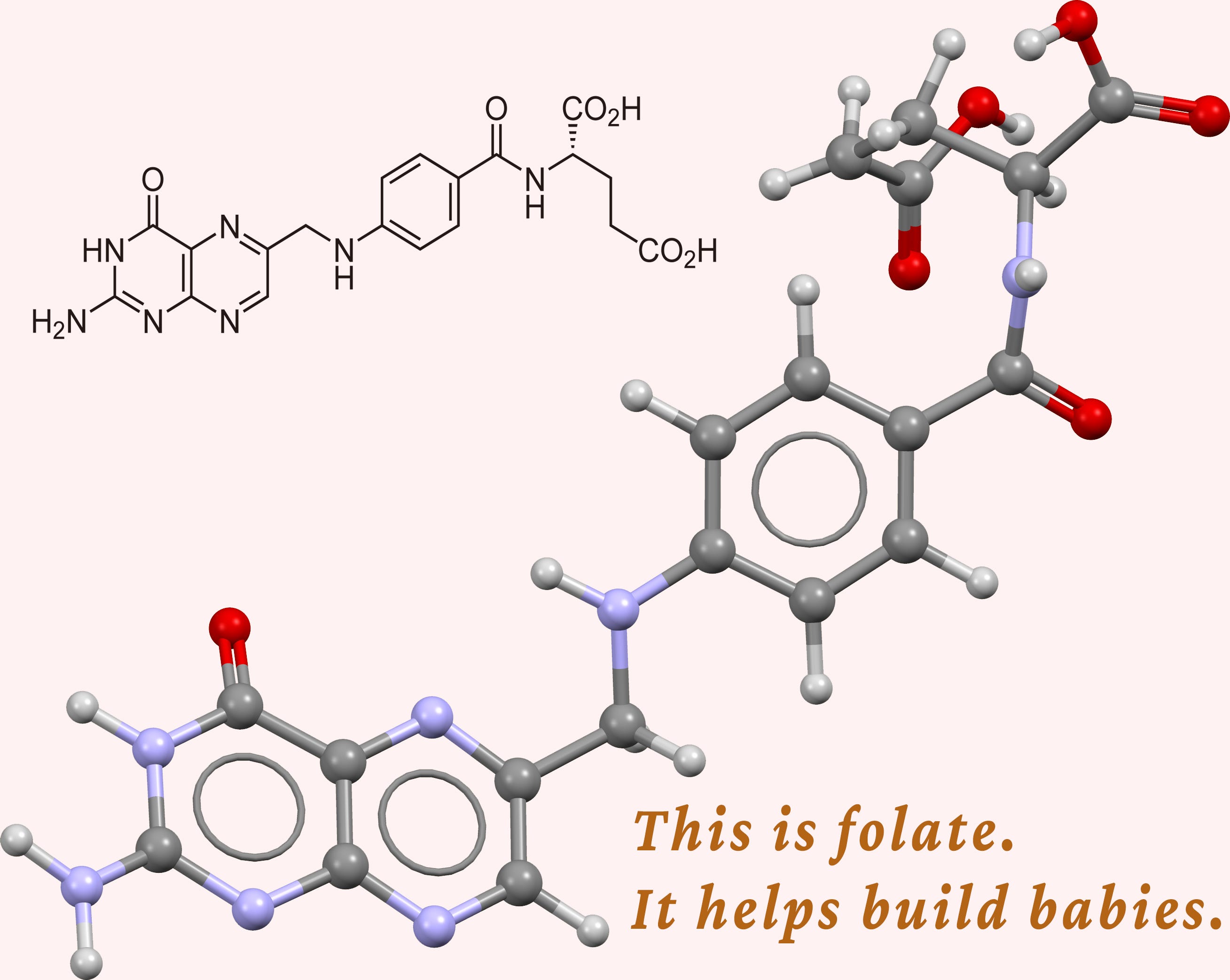
It degrades (breaks) folate, AKA vitamin B9.
So,
like virtually all things regarding life, a balance had to be reached.
We need vitamin D, because too little of it can cause rickets, soft bones, and other bone-development problems. But too much UV exposure can degrade folate, and folate matters for fertility, DNA-making, cell division, and fetal development.
Humans have a shield in our skin called melanin. It blocks UVB radiation, keeping UVB from damaging folate as it circulates near the surface of your skin where the sun does shine.
Too little melanin under a high-UV sun, and we start having statistically higher rates of health issues that prevent us from winning at life (having grandkids). But too much melanin under a low-UV sun, and your body may not get hit with enough UVB to synthesize a healthy amount of vitamin D.
So,
When some of our ancestors moseyed on out of Africa and up north, they first said goodbye to that closest, shared grandpappy, and then they started dying.
Why?
Lots of reasons, really. Fewer from malaria-laden mosquitoes, more from hangry bears. But humans who went to Europe had an additional problem. Less sun. The further away from the equator you get, the less direct the sun is hitting you, effectively causing you to absorb less sun. It’s SAD, really. (My promise to you as a writer, is that any article I write about the effects of melanin and UV radiation absorption in humans, is very likely to have a Seasonal-Affective-Disorder pun in it).
Not right away though. Because there is another source of vitamin D that can make up for the lower sun not kicking your body into making some. You can get it by eating critters whose skin has made vitamin D! That’s what early Europeans did. They ate a lot of fish and small game, so they got enough to make up for the lower amount the lower sun was causing their skin to make.
The surprising implication of this
Recent information has told us something incredibly interesting about Europeans. For most of the time people have lived in Europe, dark skin was the default colour humans came in. Humans have been in Europe for roughly 50,000 years.
The pigmentation-related genes changed, affecting how much melanin was produced and distributed, resulting in paler skin. While there would have been individuals born with lighter skin all throughout human history, evolution popularized “white people” in Europe around 8,000–10,000 years ago. It wasn’t a sudden thing, like someone who looks like a native of Ethiopia having a baby that looks like it came out of a typical Kansas home. It was a process that took many generations, and occurred at the population level, not the individual level.
Europeans weren’t all dark-skinned and then suddenly all had light-skinned babies that replaced them. Statistically, over time, the entire breeding population became lighter and lighter, because those who did got more sun, and would be more likely to have grandkids without cardboard skeletons.
In fact, skin became lighter precisely to the level that balanced the deaths from sunburnt folate with the deaths from a lack of vitamin D.
But why were white people invented only 8-10 thousand years ago if they were in Europe for ~50 thousand?
Well, they weren’t “invented.” There have always been humans born with different levels of skin pigment naturally, even in the same family.
What happened 8–10 thousand years ago, as far as we currently know, is that the pressure for less pigment became a consistent, aggregate evolutionary pressure. Over many generations, variants associated with less skin pigment became more common, and the population’s average skin colour became more and more pale.
Okay fine. Why were white people popularized in Europe only 8-10 thousand years ago if they were there for ~50 thousand?
This is the incredibly interesting part. It was because of the most impactful discovery humans have ever made. Planting and harvesting your own food. Agriculture. People in modern day Europe were hunter-gatherers for the first ~40,000 years. Their diets were heavy in D. Lots of fish and game.
But 10,000ish years ago, Anatolian-Aegean (modern day Turkey-Greece) Neolithic farmers brought agriculture into Europe, then mixed, traded, competed, and sometimes intercanoodled with local hunter-gatherer populations.
Plants, though, have extremely low levels of Vitamin D. So now, not only were Europeans (and the incoming pre-Turky Turks and pre-Greek Greeks) having their skin produce less Vitamin D because their dark skin was blocking UVB radiation… but now, settling down on the farm meant that they ate more plants, less game and fish.
This change in diet would have been a strong factor contributing to reaching the statistically-lethal breaking point. This drop in Vitamin D increased the rate of people being born with weak/soft bone issues, resulting in rickety kids, and osteomalacia (basically “adult-onset rickets”) in grown-ups.
There was now a STRONG evolutionary push for something to change. And what did change, is that the babies born with the genetics that resulted in less melanin production, had statistically fewer issues with their bones, and so had more kids passing that along.
So,
Evolution did what evolution does. Babies kept coming out with on average a hundred or so random mutations (that’s roughly how many there are in newly manufactured humans, after their parents’ DNA’s are unzipped and zipped back to make baby’s first double-helix), and natural selection weeded out more of the people born without the “fittest genes” for their environment.
Variants in genes like SLC24A5 and SLC45A2 became more common in European populations, contributing to reduced pigmentation. They lightened up, helping prevent SADness from the lack of sun.
So,
White skin is just an emergency response to living too far away from the middle of the Earth and not eating enough fish and game.
The difference between “white people” and “black people”: not different types, not evolutionary ranks, just populations with different pigmentation adaptations.
If we want to get linguistically anal (and who doesn’t), evolutionarily, there is no such thing as “black people” or “white people”. There is no set of “black people genes” that you could put into one bucket, and “white people genes” you can put into another. “White” and “Black” people are social shorthands at best, not genetic buckets. In honesty they don’t even function well as social terms. A white man from Toronto who grew up with a black friend at a similar socio-economic status is much more similar socially than that white Torontonian is with a white guy from Croatia.
Skin colour pigmentation is just a variation in how much natural sun-block we have on at all times. For convenience, we use the terms white and black people, but we should understand when we do, that we do so for simplicity, sloppy as those terms are.
In reality, there are no “black people” or “white people.” There are just people. And people come in a range of skin shades.
Matt’s question only exists because he thinks branches are rungs. He thinks one population should climb out of another, and the old one should vanish behind it. But evolution does not work that way. Populations branch, adapt, remain, mix, move, and change. Black people are still here for the same reason every other living branch is still here: they were never an obsolete rung on the way to Matt’s imagined destination.

Footnotes:
Teleology (The study of ends or purpose)
teleo — “end, final cause, purpose” (Greek -télos)
-logy — “study of, discourse about” (Greek)
Treating something (evolution) as if it works toward a goal or purpose, rather than through biological science’s explanation: selection pressures acting on whatever variations happen to arise. Evolution has no foresight.
Examples:
Saying “birds have wings in order to fly” is a teleological claim.
Saying “wings evolved through natural selection because they provided a survival advantage” is a non‑teleological claim.
English and German didn’t truly come from Flibbityfloop. The ancestor language that both English and German came from is called Proto-Germanic. I just didn’t want to say it in the main article, because it could be mistakenly seen as “German is more closely related to the ancestor language than English is.”
In reality both languages have been diverging from Proto-Germanic for the same amount of time, and have changed in different directions from their ancestor. If someone were speaking Proto-Germanic today, both modern English speakers and modern German speakers who attempted a conversation would think that Mr P-G was having a stroke.
Evolution Demonstrated with Text:
Before getting to the demonstration, we need to kill one cartoon version of evolution.
Evolution doesn’t go:
lizard —> lizard egg —> lizard —> lizard egg —> chicken
New species do not pop out of old species like a bad magic trick. Populations change over time. Sometimes they split. Once they split, each side keeps changing in its own direction.
Let’s start with Species A.
Species A’s “code” is: TTTT
In this text-based biological system, One of the four letters that make up the code of a species changes with every generation. So Species A’s generation that on average has the TTTT code, births the next generation where the kids who survived and had kids themselves best were the ones that randomly had the TTQT code. So now Species A’s code is, on average, TTQT.
The next 5-generations of TTQT:
TSQT
RSQT
RSQH
RTQH
RTPH
So now after a half dozen generations, Species A’s “code” is RTPH.
There is no longer a species with code TTTT - that species has evolved over time into RTPH.
Let’s go back to the beginning, and we’ll split Species A’s population with something in the way, like a mountain range, or the opening of a new sea over millions of years.
When a species’ population is split because of geographic isolation, that’s called allopatric speciation. This is the most common cause of speciation.
And the most common cause of allopatric speciation, is by a change in the environment such as a new mountain range or opening sea cuts a population of a species in two, keeping them from ever seeing each other, much less go on a date with each other. When this is the cause of allopatric speciation, it’s called allopatric speciation by vicariance.
So now, there are a bunch of Species A’s on both sides of our mountain, no longer able to hook up with each other.
Our two identical groups:
TTTT | TTTT
Species A, Group 1: TTTT
Species A, Group 2: TTTT
Since they are no longer bound to each other (meaning they are no longer interbreeding, due to rock-blocking), their next generation, now with two randomly mutating populations, with different selection pressures, for examples:
One side of the mountain is mostly forest, the other side is mostly swamps. Spe-Pop A’s favourite food is more common in swamps than in the forests, so the swamp-side group has an easier time meeting its nutritional requirements.
But Spe-Pop A‘s second most deadly predator hates swamps, so there are far more of them on the swamp side.
So obviously, while both groups are independently changing their code slowly over time through the random mutation side of evolution, some changes will be more or less beneficial to one group vs the other.
What happens next generation?
The separated groups may now be:
TTQT | TRTT
What happens now if members of the two groups meet somehow and canoodle? Since their codes are so similar, they can still have little baby Spe-Pop A’s together, with a combination of both codes, just like all offspring are made up of a combination of codes of its parents.
Let’s run a couple more generations forward from:
TTQT | TRTT
TVQT | TRLT
TVPT | TRBT
What happens now if they meet and mate?
Still works. Kind of. They have offspring that are a combination of both, but that combination is different enough that the resulting young do not develop the ability to have offspring themselves. This is called hybrid sterility. As an example, mules are infertile hybrids produced by breeding a horse and a donkey. Since they themselves cannot reproduce, as far as evolution is concerned, it’s a dead end - the offspring never pass their randomly mutated genes on to any of their own, since they cannot.
This is one common way species boundaries show up.
We now have:
Species B: TVPT
Species C: TRBT
Species A is gone. Only its two descendant species, B and C are here now.
Let’s watch how they continue to randomly change, diverging from each other more and more over more generations:
TVPT | TRBT
TVPE | TRRE
OVPE | TRBE
NVPE | TRBF
So now,
Species B: NVPE
Species C: TRBF
The two species don’t even look the same anymore! Their code is so different from each other now, that they can’t have offspring at all, sterilized or not. The female’s body just won’t grow an egg fertilized by the over-the-mounters.
This is what was happening to humans before modernity allowed humans to canoodle all over the world. Does that mean the different “races” of humans are sub-species? Nope. Not even close. That process typically takes hundreds of thousands to millions of years in animals that have generations that are 1-year long. On average, a human generation is 25-years long, so each kick at the random genetic can (aka having a child) is a quarter century apart. Four generations in a century instead of a hundred.
The “ASCII code” of humans in 2026:
Africans: TTTT
Asians: TTTT
Europeans: TTTT
Australian aboriginals: TTTT
Canadian aboriginals: TTTT
The Finns: TTTT
Tom Cruise: TTTT
The Pope: TTTT
Jeffrey Dahmer: TTTT
St. Nicholas: HOHO
⠀
Bonus Content for Paid Subscribers
The article above is complete.
Below is a little extra content to say thanks to my paid subscribers.
