

Some questions are too important to answer carelessly.
Some questions have divided families, ruined dinner parties, consumed comment sections, and caused otherwise ordinary people to begin speaking as though they are defending civilization from a fog machine.
So today, with the seriousness this topic deserves, we begin at the beginning.
PART I: The Sloppy Linguist
»-(¯`·.·´¯)->
What is a chair?

Define chair in a way that includes all chairs and excludes all non-chairs.
Seems simple.
We begin with the standard definition:
“A chair is a four-legged thing you can sit on.”
Brilliant.
Simple.
Clean.
Direct.
The kind of definition a person can say with confidence.
⠀
So,
ô¿ô
⠀
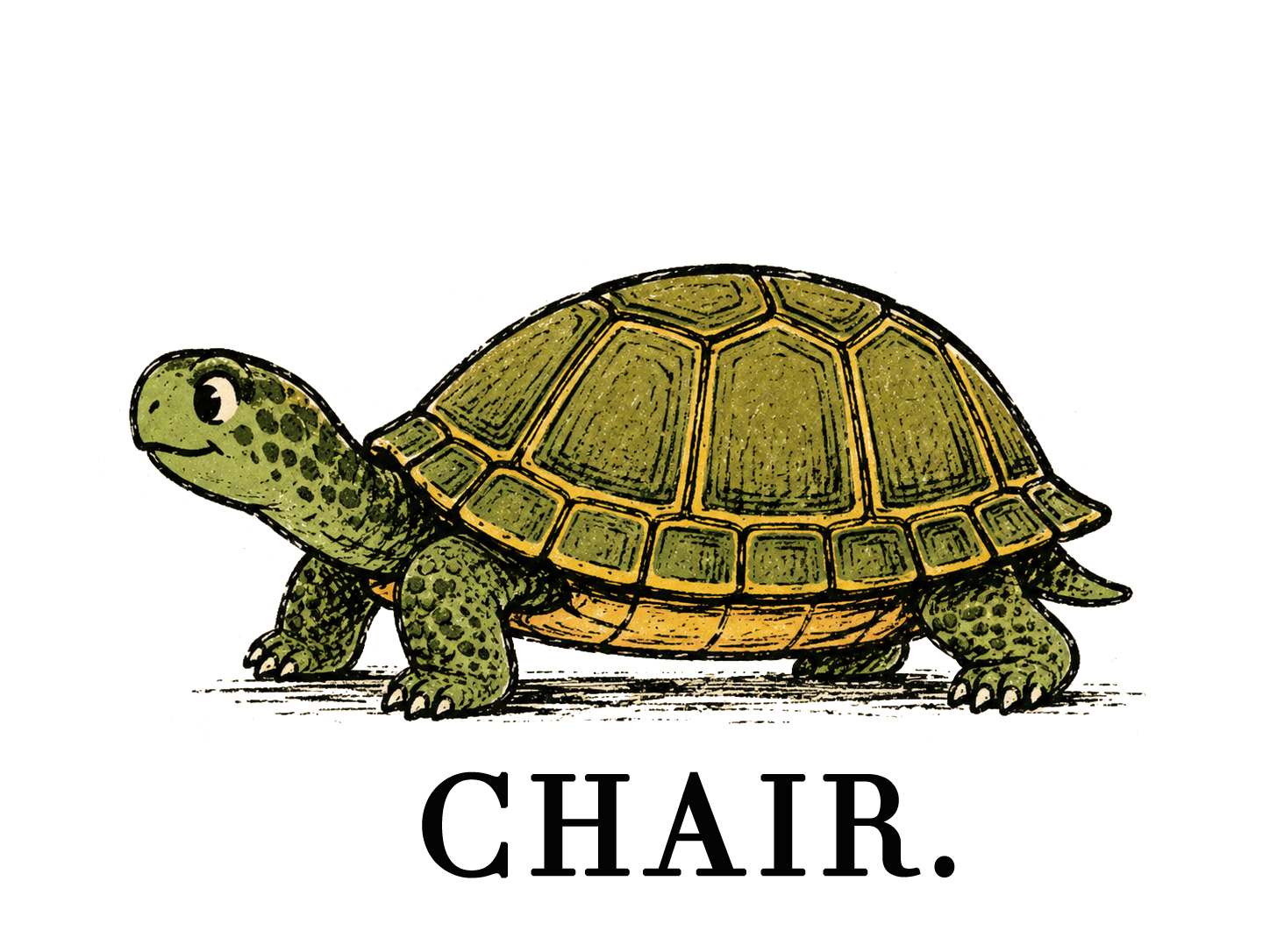
So, the first definition survives all but half of six seconds.
“This is obviously not what anyone meant”.
The turtle has four legs.
You can sit on it, at least briefly (if you have no respect for turtles).
⠀¸.·´¯`·.´¯`·.¸¸.·´¯`·.¸>((º>
⠀
So, the definition receives its first emergency repair.
“An INANIMATE four-legged thing you can sit on”.
Better.
Sharper.
More precise.
.
..
…
… (-(-_(-_-)_-)-) …
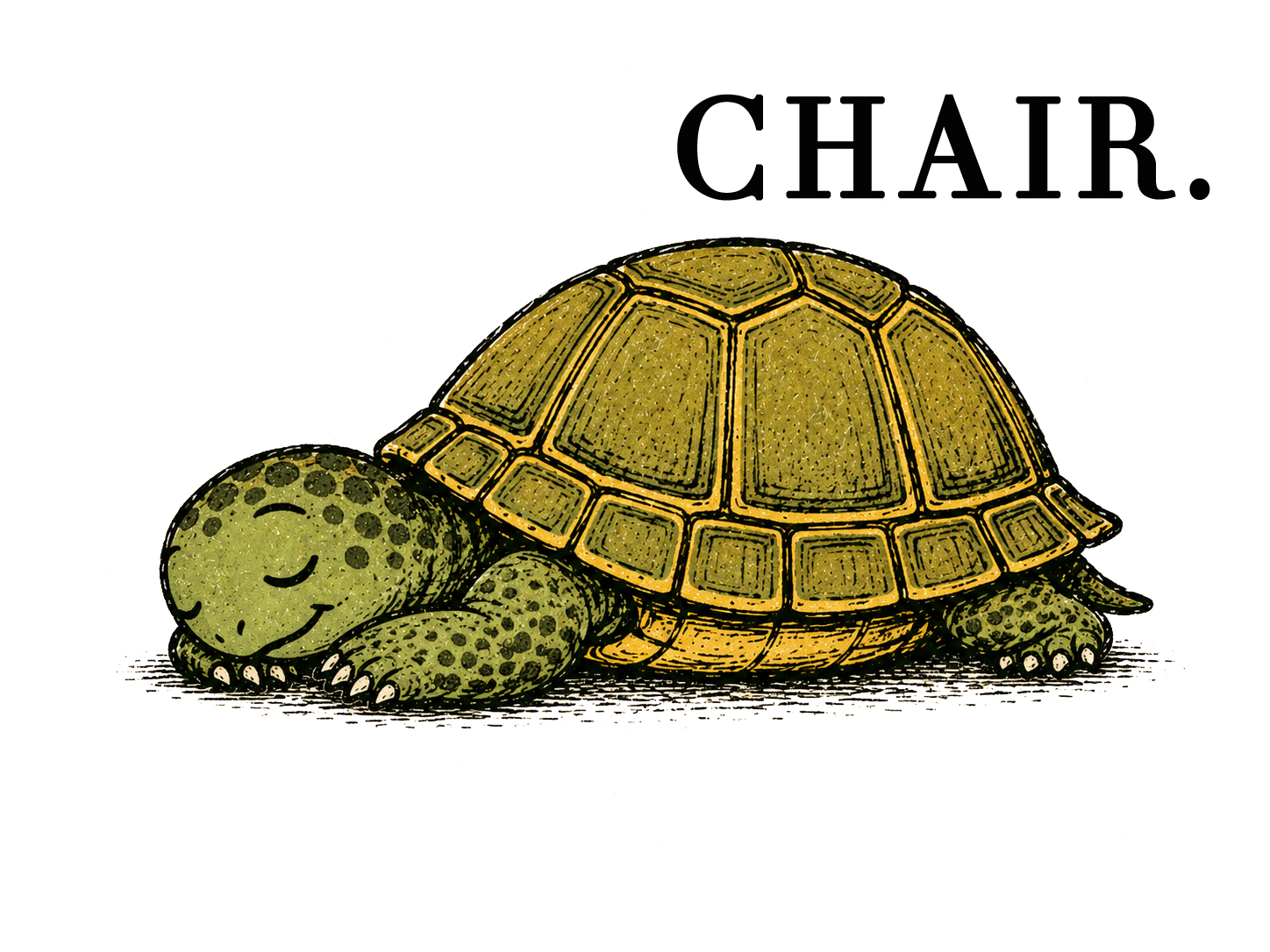
• The definition has been patched for precision.
⠀
• Precision immediately creates new problems.
⠀
At this point, the Sloppy Linguist begins to sweat. Not because language has failed, but because the first patch was not designed to describe chairs.
It was designed to exclude turtles.
⠀
That’s different.
⠀
The purpose of the definition has quietly changed.
It is no longer trying to help us understand the object.
It is trying to defeat the counterexample.
⠀°º¤ø,¸¸,ø¤º°`°º¤ø,ø¤°º¤ø,¸¸,ø¤º°`°º¤ø,¸
⠀
So, the definition receives its second emergency repair.
“No. It cannot be alive.”
⠀
Okay,⠀⠀⠀⠀ ⠀⠀ ⠀⠀⠀⠀@(’_’)@
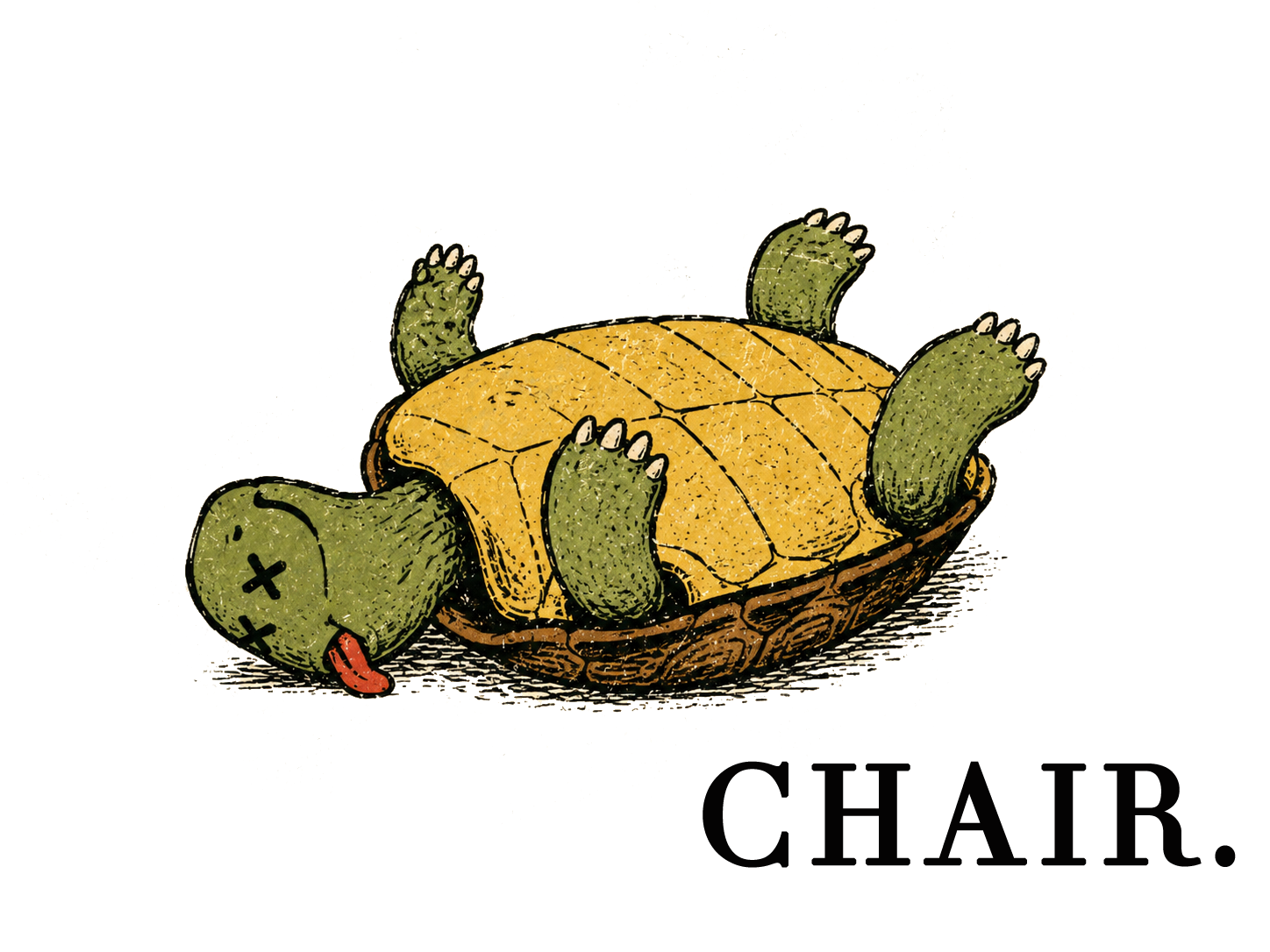
• The category is becoming narrower, uglier, less useful.
• This is common during definitional emergencies.
⠀
A normal speaker would say, “That’s not a chair, that’s a turtle!” and everyone would understand them. But the Sloppy Linguist cannot allow ordinary understanding to do its ordinary work. The Sloppy Linguist needs a perfect checklist. The Sloppy Linguist needs a definition so pure that no turtle can ever sneak through customs.
The Sloppy Linguist is not sloppy because he lacks precision. He’s sloppy because he mistakes precision for understanding.
So the next emergency patch arrives.
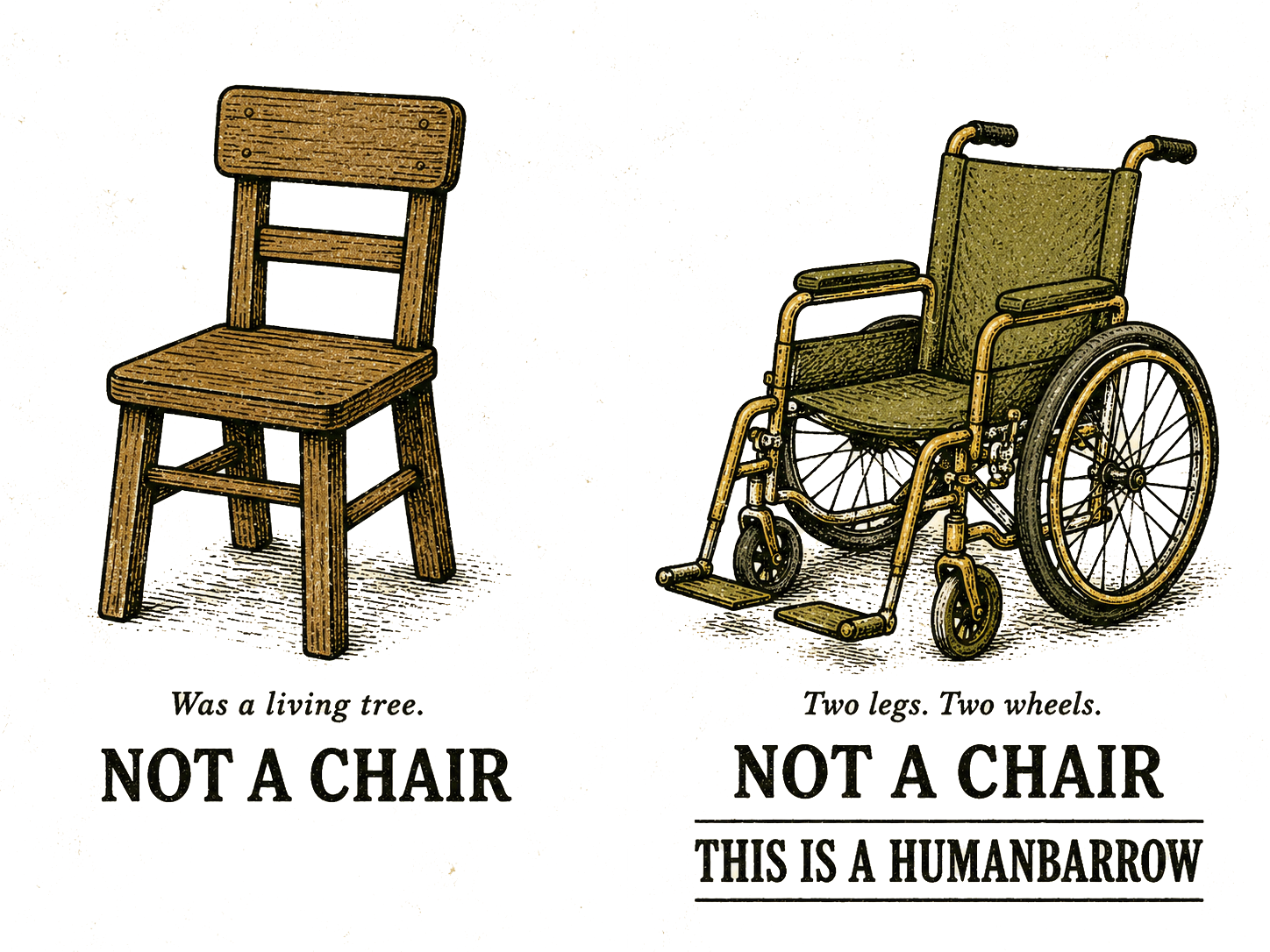
“No. It cannot be alive and cannot ever have been alive.”
⠀⠀
Magnificent. ✌⊂(✰‿✰)つ✌
⠀⠀
We are now approaching maximum linguistic rigour.
So,
⠀༼☉ɷ⊙༽
⠀
And there it is.
The cursed taxonomic reality that comes with hostile precision over cooperative interpretation and establishing shared axioms.
The wooden chair has been expelled because the wood was once alive.
The wheelchair has been reclassified because the checklist cannot survive its wheels.
The definition has become so committed to protecting itself from turtles that friendly-fire has shot down the entirety of accessibility-furniture.
⠀
This is the point where a sensible person should stop and ask whether the definition is still serving language, or whether language has been chained to the radiator and is being pelted mercilessly with spare Oxford commas.
A good definition is not the most rigid sentence you can produce. A good definition helps people coordinate meaning.
⠀⠀⠀⠀⠀(⌒▽⌒)
The required resolution depends on the job.
⠀
A barista needs to know where the chairs go.
A furniture designer needs measurements.
A safety inspector needs load ratings.
A moving company needs to know what can be stacked, lifted, wrapped, and charged for.
A museum curator may care whether something belongs to a lineage of design.
None of these people are wrong for using different resolutions.
They are doing different tasks.
⠀(/.__.)/⠀ ⠀ ˁ˚ᴥ˚ˀ
⠀
Philosophers would file this under Wittgenstein’s idea of words having “family resemblance”.
The turtle-chair disaster above shows the problem nicely: we kept looking for the one feature that all chairs must share, and every attempt either let in something stupid or kicked out something obvious.
Four legs failed.
Inanimate failed.
Never alive failed.
Wheels broke the machine.
That is where family resemblance becomes useful.
Some categories, or words (which are categories), hold together less like identical products from a factory, and more like relatives at a family reunion.
You may have:
Your cousin’s chin-line,
Your aunt Lucy’s eyes,
Your father’s posture,
Your uncle’s laugh, and, depending on the family,
Your grandmother’s tail.
No single feature belongs to everyone. But the resemblance overlaps enough that nobody needs to discover the family’s secret metaphysical ingredient before recognizing the reunion.
A dining chair, a throne, a stool, a beanbag, a folding lawn chair, and a wheelchair work more like family resemblances than rigid hierarchies of meaning, whether the Sloppy Linguist wants to admit it or not:
They overlap.
SOME chairs have legs.
SOME chairs have backs.
SOME chairs are movable.
SOME chairs are built for one person.
SOME chairs are mostly defined by sitting.
SOME chairs are defined by the role they play in a room.
No single feature does all the work.
⠀\(^-^)/ ( ͡° ͜ʖ ͡°) \(^-^)/
⠀⠀⠀⠀⠀⠀⠀⠀
The word, or category, holds because enough features overlap in enough ordinary contexts for people to keep understanding each other.
And understanding each other is the entire point of words in the first place, so understanding what each’s other means, exactly, by a word, is paramount.
If two people are arguing over an equation, but one of them thinks X means 4 and the other thinks X means 9, the problem is not the arithmetic, and no amount of mathing is going to get both sides to agreement. They can show their work all day long, use the same names for their different values—the entire time, never touching the same question.
Words work the same way.
⠀(ノಠ益ಠ)ノ彡⠀
⠀
Before people can argue about what follows from a word, they need some shared understanding of what the word is doing in the conversation.
That does not mean definitions are useless.
It means definitions are tools.
And tools are judged by the work they are being asked to do.
⠀
The Sloppy Linguist
Flips the table and
Gets this
Exactly backwards.
⠀
(╯°□°)╯ ︵ ┻━┻
⠀
He mistakes taxonomic cleanliness for understanding. Precision for accuracy. He sees fuzzy edges and assumes language has failed. So he sharpens the definition until it can cut through anything, including the thing it was supposed to describe.
• • • This is not rigour, • • •
• • • This is how you get a humanbarrow. • • •
⠀⠀
PART II: The End

Objectification Done Right:
I figured after that long article, we could all do with a little good ‘ol fashion objectifying:


Steven, I think you've identified a genuine problem, but I'm not convinced you've answered the question your title promises.
The strength of your essay is not that it tells us what a woman is. It shows why demanding a single, context-free definition often fails. The chair example is entertaining precisely because it demonstrates how quickly necessary-and-sufficient definitions become absurd.
Where I think we differ is in what follows from that observation.
I don't believe the question *"What is a woman?"* is the most important one. The more important question is: *"What do we mean by 'woman' in this discussion?"*
Language only works because speakers implicitly agree on the rules of the language game they are playing. Problems arise when they don't.
If two mathematicians use **x** to mean different values, no amount of algebra will resolve their disagreement until they first agree what **x** represents. The problem is not mathematics; it is semantics.
The same applies here.
There is no reason to assume that every conversation requires the same definition of *woman*. A geneticist, an obstetrician, a lawyer, a sociologist and an anthropologist may all use the word legitimately, but for different purposes and with different criteria. None is necessarily wrong. They are simply playing different language games.
The mistake is to begin arguing about the implications before agreeing on the rules.
If, for the purposes of one discussion, both participants agree that "woman" means an adult human with an XX karyotype, then the discussion proceeds on those terms. If another discussion is about legal recognition or social identity, a different definition may be entirely appropriate. The crucial point is that everyone knows which game is being played before the debate begins.
In that sense, I think Wittgenstein's lesson is slightly different from the one you draw. It is not that words have no stable meaning. It is that meaning is inseparable from use. Stability comes from shared use within a context, not from discovering a metaphysical essence.
So I would answer the Internet's most exhausting question rather differently.
Don't ask, "What is the one true definition of woman?"
Ask, "What definition of woman are we agreeing to use for this conversation?"
Once the rules are agreed, people can disagree productively. Without that agreement, they are often not disagreeing about reality at all—they are simply playing different language games while believing they are playing the same one.
That's part of the problem; the same word "woman" is doing work in three categories. Are we talking biology? Sexuality? Social roles? In every case, the criteria are similar, and there's a lot of overlap, but no definition that will unify all three. Since gender is quite as objective as we thought, how do we define it? Fall all the way to subjectivity, where "woman" is a tautology? What is a USEFUL definition? Or would a meaning-cluster be more appropriate. Is there a statistically significant portion of the population deviating from the norm, or is it just some edge cases? You have to draw the line SOMEWHERE, or the categories mean nothing. But where?