

This page is part of The Argument Field Manual (tAFM)—a living field guide to bad reasoning, rhetorical tricks, semantic sludge, broken mental models, evidence games, loaded language, tribal cognition, and other machinery that makes public thinking stupid.
TAFM → The Move → Aggressive Moves → Distortion Attacks Guide
This page collects a closely related family of concepts. Use it to identify what you’re seeing in the wild, then follow any linked full articles for deeper autopsies, examples, and repair strategies.
Distortion Attacks alter the target before attacking it. The claim, representative, context, implication, or scope is quietly changed so that defeating the substitute appears to defeat the original.
⠀⠀
Table of Contents \ Distortion Attacks
Strawman \ Attacking a distorted version of the claim.
Weakman \ Attacking the weakest representative of a position.
Nutpicking \ Treating the craziest example as the real argument.
Straw-Mascot Defense \ Weaponizes the cleaner version to make the critic look cruel or deranged.
⠀⠀
• Strawman
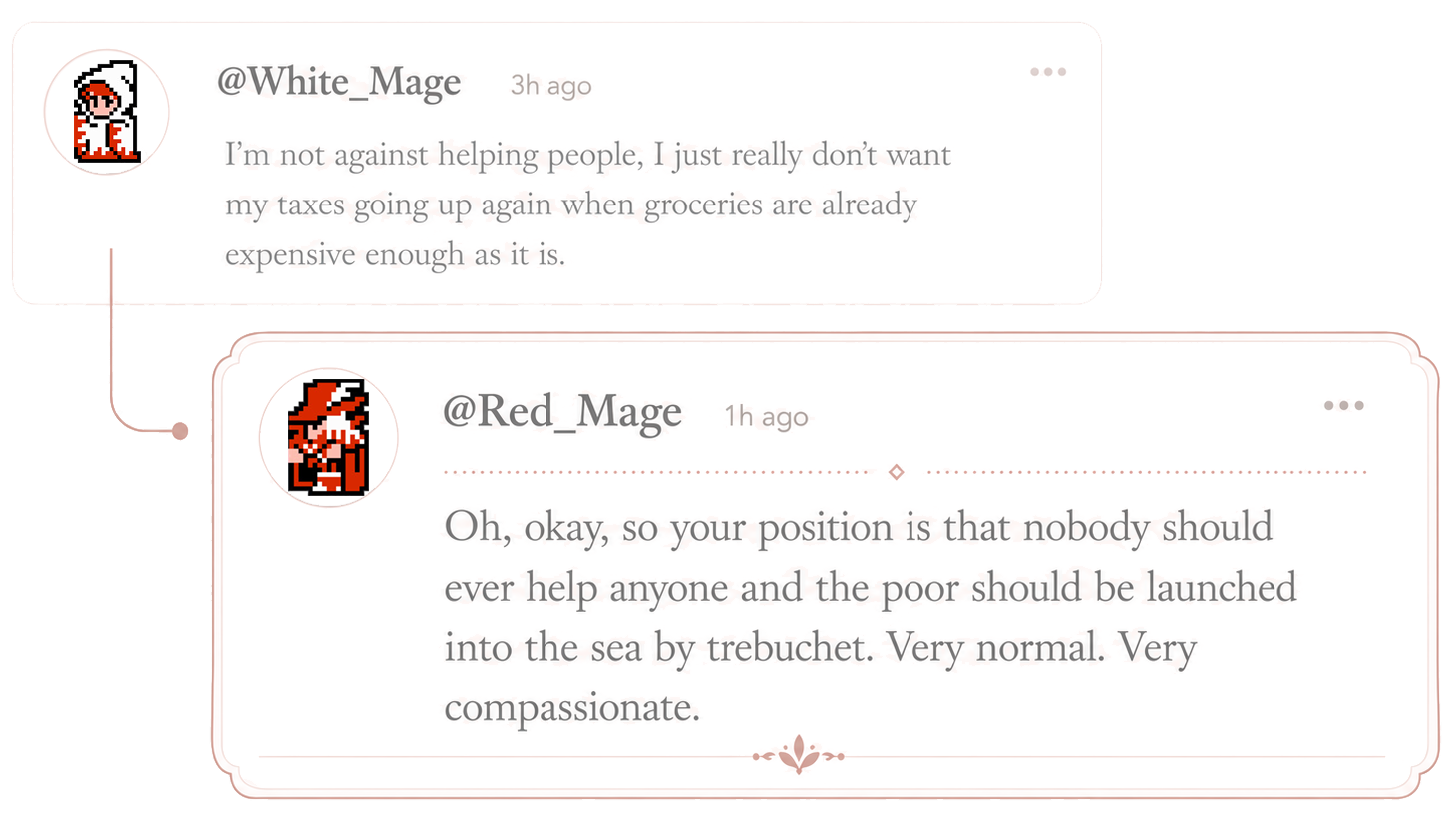
What’s happening here?
The person is not answering the claim. They are building a worse, dumber, easier-to-kill version of the claim, stapling your name to its shirt, and then attacking that instead. This is debate taxidermy: technically shaped like your argument, but dead, stuffed, and posed for their convenience.
Core definition:
A strawman is attacking a distorted version of a claim instead of the claim actually being made.
You’ll recognize this when…
Someone begins with “So you’re saying…” and then says something you did not say, would not say, and may have explicitly ruled out before their little argument-cartoon was wheeled onto the stage.
It often turns a limited claim into an absolute one, a causal claim into a moral confession, or a criticism of one thing into hatred of an entire category.
Why it matters:
The strawman is one of the basic units of public nonsense because it rewards speed over accuracy. It lets the attacker feel brave while fighting a cardboard cutout they made during arts and crafts.
Miss it, and the conversation becomes a trial over a position nobody holds. Then everyone wastes ten minutes arguing about whether you hate puppies, democracy, medicine, or whatever other hostage got dragged into the room.
Related concepts:
Steelman, Claim Compression Check, Plain-Claim Translation, Scabbard Removal, Bad-Faith Accusation
Common disguise:
“I’m just following your logic.”
Common escalation:
When corrected, the attacker says, “Well, that’s where your argument leads.”
Repair move:
“Quote the claim you’re answering. Not the haunted-house version. The actual claim.”
☝️ Up to TOC 👆
⠀
• Weakman
A weakman is attacking the weakest representative of a position while pretending you have answered the position itself.
Composite specimen:
“I found a TikTok with twelve likes where someone on your side said the moon is sexist, so I think we can safely declare your entire position intellectually deceased.”
What’s happening here?
The person has found a weak representative of a position and treated it as the real position. Not the strongest advocate. Not the central claim. Not the best version. The weakest available specimen, preferably one already chewing drywall in public.
This is not analysis. This is rummaging through the opposition’s trash until you find something smelly enough to hold up as their constitution.
You’ll recognize this when…
Someone says “this side believes…” and their evidence is one crank, one teenager, one meme, one bad viral post, or one low-resolution idiot with a ring light and confidence poisoning.
It usually depends on visibility being mistaken for representativeness.
Why it matters:
Weakmanning trains people to judge ideas by their worst fans. That is emotionally satisfying and intellectually useless, which means the internet will continue paying it overtime.
Every serious position has bad defenders. Every movement has mascot idiots. If bad representation were enough to destroy an idea, there would be no surviving ideas. There would just be screenshots and smoke.
Related concepts:
Strawman, Nutpicking, Steelman, Central Case Check, Visibility Is Not Prevalence, Mascot Case Check
Common disguise:
“This is what they really believe.”
Common escalation:
When challenged, the person produces three more terrible examples, as if stacking raccoons creates a horse.
Repair move:
“Is this the strongest version of the position, or just the easiest one to mock?”
☝️ Up to TOC 👆
⠀
• Nutpicking
Nutpicking is treating the craziest or most extreme example of a group or position as representative of the whole.
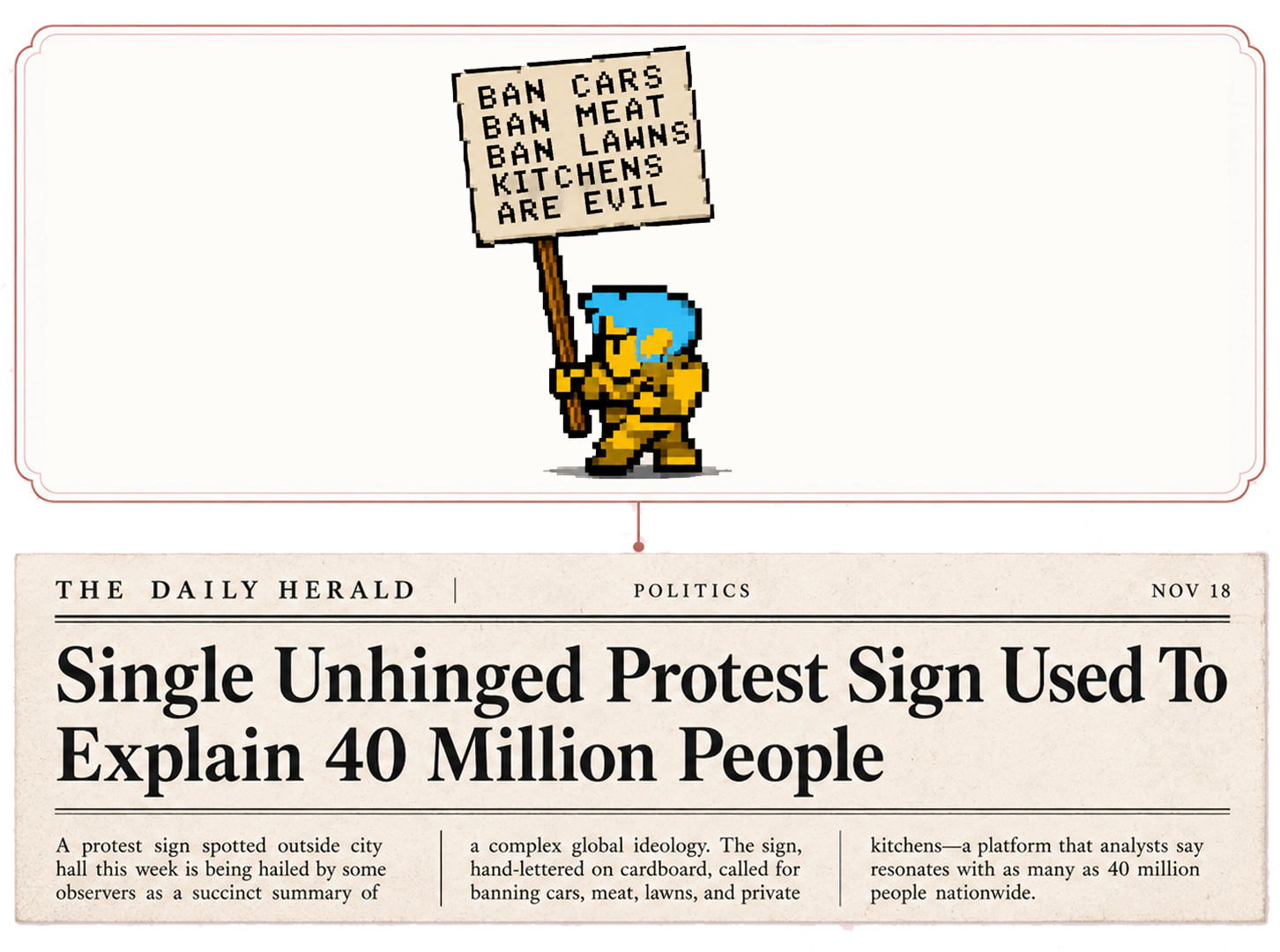
The outlier becomes the embassador
The craziest available example is being treated as the real argument. The nut is picked, polished, framed, and introduced to the audience as the official ambassador.
It is weakmanning with a special fondness for lunacy. A specimen hunt where the hunter only shoots the diseased squirrel and calls it “the forest.”
⠀
You’ll recognize this when…
A person uses a fringe voice, deranged comment, weird protest sign, or high-engagement freakout as proof of what “these people” believe.
The giveaway is that the example is doing two jobs at once: representing the group and disgusting the audience.
⠀
How to: Build a Nut Into a Mascot
Take a population: A large, varied group or position.
Select a specimen: The weirdest, loudest, ugliest, most shareable outlier.
Representation swap: Treat the outlier as the central case.
Emotional payload: Foment disgust at the individual to do the work that evidence should be doing.
Result: The audience thinks it has inspected the group when it has only met the group’s least stable raccoon.
⠀
Some Nuts Matter
The nut is not automatically irrelevant. It becomes nutpicking when visibility gets laundered into representativeness.
An extreme example can matter if it is influential, widely endorsed, institutionally protected, predictive of a wider pattern, or treated as legitimate by the group’s actual center of gravity.
Nutpickers usually skip that work. They grab the most shareable lunatic, staple extra lunacy onto the specimen through exaggeration or selective framing, and call the resulting little goblin scarecrow “their movement”.
A hysterical “Nut” of a passenger shouting about their concerns may be terrible evidence for the emotional health of your car—but they may still be providing excellent evidence that an oncoming truck is drifting into your lane.
⠀
Why Nutpicking matters
Nutpicking turns public reasoning into a freakshow economy. Whoever can find the most embarrassing outlier wins the emotional weather.
It also destroys your ability to see the sane version of a view. Once the nut becomes the mascot, every ordinary person nearby gets judged by association. That is not thinking. That is contamination with screenshots.
⠀
Related concepts:
Weakman, Availability Heuristic, Base Rate Check, Prototype / Outlier Confusion, Central Case Check, Edge-Case Quarantine
⠀
Common disguise:
“I’m just showing what’s out there.”
⠀
Common escalation:
The outlier becomes the lens through which every normal example is interpreted.
⠀
Repair move: The Centrality Check
Is the example being held up as a Nut central, common, influential, endorsed — or merely visible?”
Central: Is this close to the group’s actual mainstream position?
Common: Does it appear often enough to matter?
Influential: Does it shape decisions, policy, incentives, status, or behavior?
Endorsed: Do meaningful authorities, members, institutions, or normal participants defend it?
or,
Merely visible: Is it just loud, weird, viral, or algorithmically delicious?
A nut may prove that the nut exists. The Centrality Check asks whether it proves anything about the tree.
⠀
Field Notes
Nutpicking works by converting visibility into representativeness and disgust into evidence.
☝️ Up to TOC 👆
⠀
• Straw-Mascot Defense
A Straw-Mascot Defense is an offensive tactic, replacing your side’s real, uglier conduct with a harmless mascot version, then using that mascot to portray critics as unreasonable, cruel, hysterical, or dishonest.
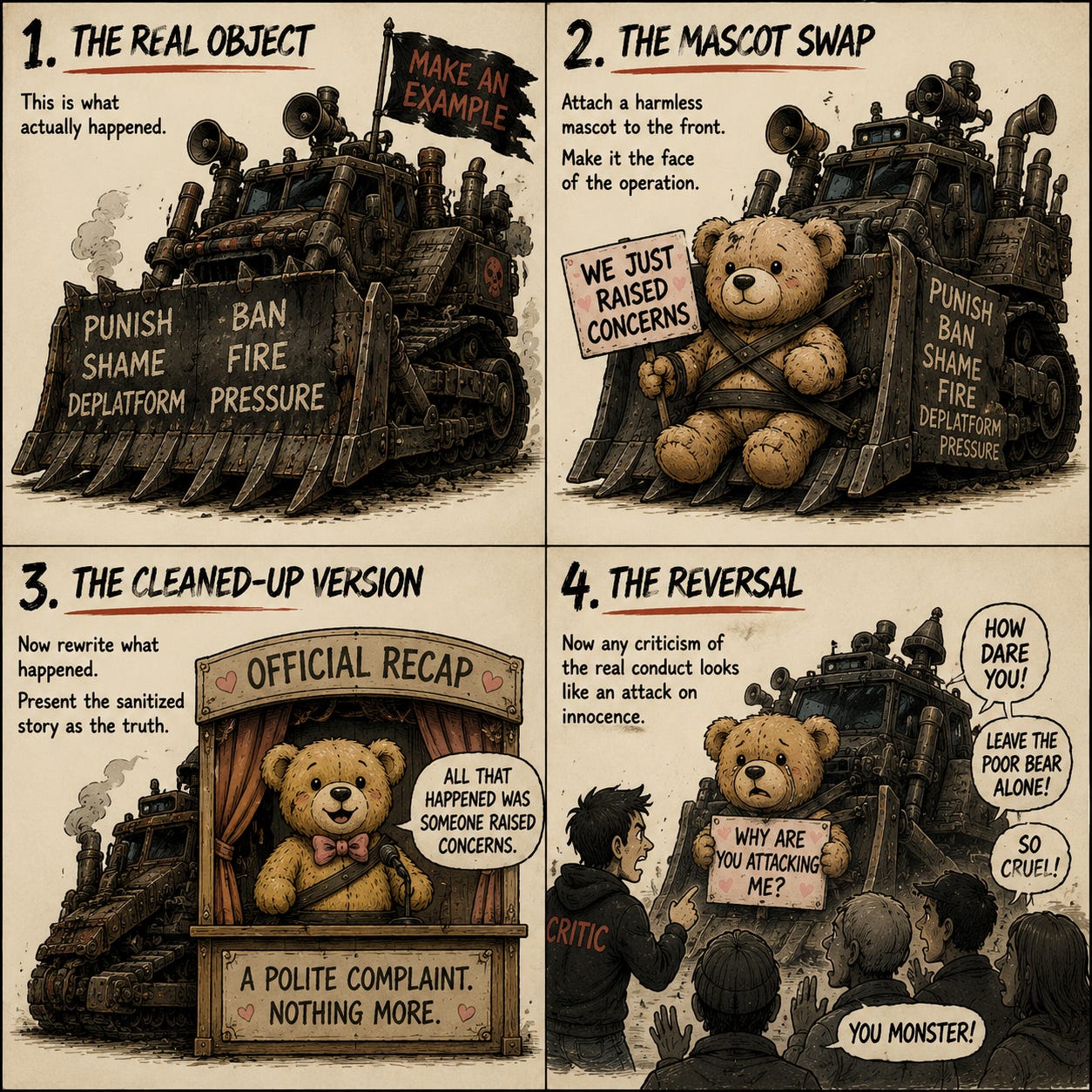
What got weaponized?
A Straw-Mascot Defense starts with a self-strawman, but then adds a counterattack.
1. The Substitution
First, the real conduct gets replaced with a harmless mascot version.
2. The Reroute
Then, criticism of the real conduct is reframed as an attack on the mascot.
3. The Erased Target
So, while the critic was objecting to the broader demand structure, pressure campaign, institutional leverage, or punishment logic.
4. Mascot Swap
⠀⠀⠀The defender swaps in:
⠀⠀⠀• “A polite student”
⠀⠀⠀• “A lunch complaint”
⠀⠀⠀• “Someone raising concerns”
⠀⠀⠀• “A vulnerable person asking to be heard”
5. The Reversal
Now, The critic looks cruel, obsessive, hysterical, or dishonest.
This move works because the critic now has to either 1) Fight the mascot and look deranged, or 2) Spend three paragraphs dragging the actual target back into the room.
⠀
The Mascot Swap
Real object:
The actual demand, conduct, campaign, pressure, or institutional leverage.
Mascot version:
The cutest, smallest, most sympathetic representative of the behavior.
Moral reversal:
The critic becomes the aggressor for objecting to the mascot.
The trick:
The mascot is not the thing being criticized. It is the thing being protected by the criticism’s misdirection.
⠀
Field Test
Ask:
Is this the actual target of criticism, or the mascot version placed in front of it?
Also:
Who benefits if the debate stays focused on the mascot?
The tell is:
“You’re mad about that?”
Where that is not actually the thing being criticized.
Other cues:
“Why are you attacking this person?”
“They only said…”
“It was just one complaint.”
“You people are obsessed.”
“Imagine being angry about this.”
⠀
Repair Move
Separate the mascot from the target.
“That is not the object of criticism. That is the mascot version of it.”
⠀
Related Concepts
In-Group Strawman; Strawman; Weakman; Moral Reversal; Frame Capture; Victimhood Leverage; Scope Capture; Conduct Miniaturization; Claim Compression Check.
⠀
Field Notes
This is defensive in purpose but aggressive in execution: it defends the in-group by putting the critic on trial.
The Straw-Mascot Defense does not just make your side look innocent. It makes the critic look deranged for objecting to the innocence costume.
☝️ Up to TOC 👆
