
TAFM → The Move → Defensive Moves → Deflections Guide
This page is part of The Argument Field Manual (tAFM)—a living field guide to bad reasoning, rhetorical tricks, semantic sludge, broken mental models, evidence games, loaded language, tribal cognition, and other machinery that makes public thinking stupid.
Table of Contents \ Deflections
Whataboutism \ Dragging in another bad thing before answering this bad thing.
Tu Quoque \ Changing the question from “is this true?” to “are you clean?”
Argumental Hermit Crab \ Scuttling to a new reason-shell when the last one gets served an inspection warrant.
⠀
Introduction
This guide contains a closely related family of concepts, fallacies, and argument manoeuvres. Use it to identify what you’re seeing in the wild, understand what the move is doing, and choose a repair strategy before it eats the conversation.
Deflections are moves that avoid the claim under inspection by dragging attention somewhere else.
Not necessarily somewhere irrelevant in every possible universe.
Just somewhere that lets the original claim sneak out of the room with its shoes in its hands.
⠀
A deflection does not usually say:
“I refuse to answer that.”
It says:
“But what about this other thing?”
“You do it too.”
“Okay, maybe that point failed, but what about this next shell I found on the beach?”
The central trick is relocation.
*The claim was here*
*The answer goes there*
Now everyone is arguing near the issue, around the issue, emotionally adjacent to the issue — but not actually the issue.
This is how arguments become foggy little obstacle courses.
None of this discounts, bans, or calls into question:
Comparison
Context
Hypocrisy
or other side issues
Sometimes those things matter. Sometimes the “other thing” really is relevant.
The question is:
Did the new issue help inspect the original claim, or did it help escape it?
That is the Deflection test.
☝️ Up to TOC 👆
• Whataboutism
Whataboutism is a deflection where one claim is avoided by pointing at a different wrongdoing instead of answering the one under inspection.1

You’ll Recognize This When…
The answer begins with:
“But what about…”
“Funny how you never mention…”
“Where was this energy when…”
“Your side does it too.”
“Interesting that you only care now.”
The tell is not the phrase itself. The tell is whether the new example is used to inspect the original claim or to avoid it.
☝️ Up to TOC 👆
⠀
• Tu Quoque
What is a Tu Quoque?
Tu Quoque is Latin for “You do it too!" It happens when a person treats the critic’s hypocrisy as if it makes the criticism false.2

How Does This Move Work?
Tu Quoque answers a criticism by pointing back at the critic: “You do it too.” Rather than inspecting whether the criticism is true, the respondent shifts attention to the critic’s own behaviour. The accusation of hypocrisy may be accurate—but unless that hypocrisy changes the substance of the claim, it does not refute it.
⠀
How to build a Tu Quoque fallacy:
Person A criticizes Person B
Person B accuses Person A of doing the same thing
Person B treats that inconsistency as an answer, or refutation, of Person A’s criticism.
⠀
Sometimes that inconsistency really does matter. If a person’s hypocrisy tells us something about their sincerity, trustworthiness, motives, or willingness to live by the rule they are preaching, it can be relevant context.
But Tu Quoque becomes a fallacy when hypocrisy is treated as refutation.
A person’s inconsistency may weaken their credibility, but it does not automatically make their claim false. A hypocrite can still be right. A dishonest messenger can still deliver a true message.
⠀
The key diagnostic question is:
“Does the inconsistency actually change the truth of the claim, or is it just being used to dodge the claim?”
The person may be inconsistent.
The criticism may still be correct.
Some cries of “but, you!” are valid, but Tu Quoque becomes defective when inconsistency is treated as refutation.
Reality does not stop being true just because the messenger has dirty hands.
⠀
The Claim / Messenger Split
Tu Quoque gets power by welding two questions together:
Question 1: Is the claim true?
Question 2: Is the speaker consistent?
Those are not the same question.
A smoker can correctly say smoking is bad.
A reckless spender can correctly say debt is dangerous.
A corrupt politician can correctly identify corruption in someone else, though obviously you may want to keep one hand on your wallet while he does it.
Hypocrisy may reduce trust. It does not perform a tiny logical assassination on the claim.
⠀
You’ll Recognize This When…
The reply sounds like:
“You do it too.”
“Look who’s talking.”
“You’re one to talk.”
“That’s rich coming from you.”
“You only care when they do it.”
The move often arrives when the original criticism is uncomfortable but the critic has a convenient stain on their shirt.
So the stain becomes the trial.
⠀
Diagnostic Test
Ask:
“Would the claim still be true if someone less hypocritical said it?”
If yes, the hypocrisy is a side issue.
Possibly relevant. Possibly satisfying. Possibly hilarious.
Still a side issue.
⠀
Repair Move
Try:
“My consistency is a separate question. Is the claim accurate?”
Or:
“That may show I’m inconsistent. It does not show the argument is false.”
Or:
“Fine — inspect my hypocrisy next. First answer whether the criticism is true.”
The critic can be examined next. First, examine the criticism.
⠀
Related Concepts
Hypocrisy Deflection
Motive Attack
Character Substitution
Steel vs Scabbard Check
Claim Compression Check
Motive Parking
☝️ Up to TOC 👆
⠀
• Argumental Hermit Crab
What is an Argumental Hermit Crab?
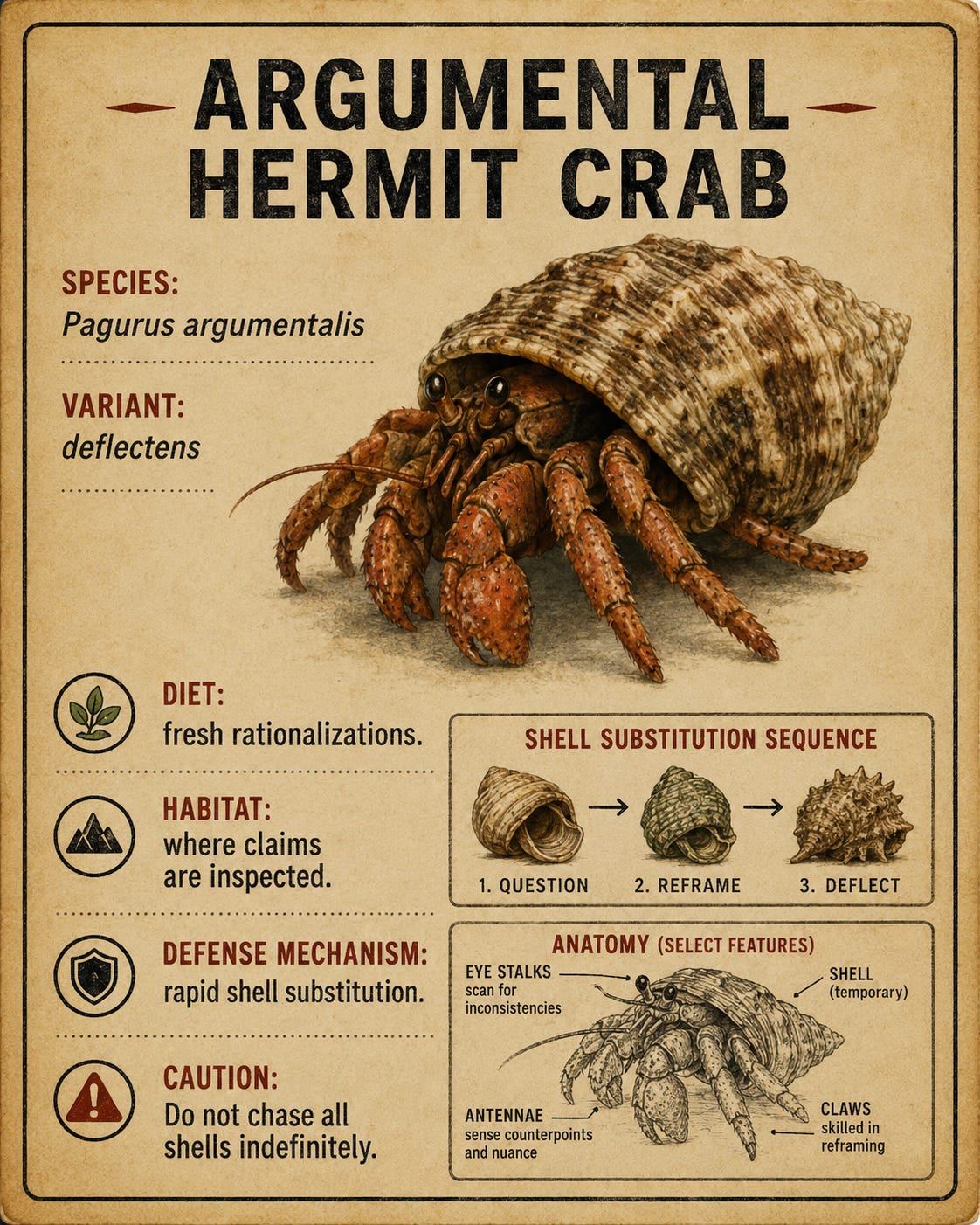
An Argumental Hermit Crab is a deflection pattern where each failed reason is discarded for a new one — often while the original confidence remains unchanged.3
How This Move Works
The Argumental Hermit Crab is what happens when someone keeps changing the reason for their belief while preserving the same level of confidence.
It is not quite Goalpost Moving. The standard is not necessarily changing after being met.
It is not quite Motte-and-Bailey. The person is not necessarily retreating from a bold claim to a safer version of the same claim.
The crab is doing something stranger.
It abandons the current claim-shell when scrutiny gets uncomfortable, then crawls into a different claim-shell and acts as if the argument has been there the whole time.
The belief survives because the reasons were never the engine.
They were temporary housing.
⠀
The Hermit Crab Scuttle
The pattern looks like this:
Claim A is offered as the reason.
Claim A is inspected.
Claim A fails.
The argument crawls into Claim B.
Claim B is inspected.
Claim B fails.
The argument crawls into Claim C.
The confidence remains weirdly untouched.
The shell changes.
The certainty does not.
That is the animal.
⠀
Diagnostic Test
Ask:
“After the claim changed, did the confidence change with it?”
If the person’s certainty survives the collapse of every reason offered, then the reasons probably were not doing the real work.
The reasons were merely decorations on a conclusion that had already moved in and chained itself to the radiator.
⠀
You’ll Recognize This When…
Listen for:
“Okay, maybe not that, but…”
“Fine, but the bigger point is…”
“That specific example may be wrong, but…”
“You’re missing the pattern.”
“This is bigger than one claim.”
Sometimes the “bigger pattern” is real.
Sometimes it is just a fog machine with scuttly legs.
The tell is whether the person updates when each support beam snaps, or ignores it ever existed and walks you over to their next support.
⠀
Repair Move
Do not chase every shell forever.
Try:
“Before we move to the next claim, are you conceding the first one?”
Or:
“What changed in your confidence after that reason failed?”
Or:
“Let’s list the reasons one at a time. Which one is doing the actual work?”
If the crab keeps scuttling:
“You’re changing supports faster than we can inspect them. Pick the claim you actually want to defend.”
Let them know you see them crawling around the beach looking for a hiding spot.
⠀
Related Concepts
Topic Drift
Question Substitution
Evidence Whack-a-Mole
Confidence Calibration
Update Demand
Claim Compression Check
☝️ Up to TOC 👆
⠀
Field Notes — Deflections
Deflections are not always inappropriate.
A deflection is not automatically false because it changes the subject.
Sometimes the subject needed changing.
Sometimes the first frame was too narrow, too rigged, too selective, too cute by half.
But when the original claim remains unanswered while attention gets dragged into a new arena, you are probably watching a deflection do its little subject-disappearing stage trick.
⠀
The core question is always:
“Are we clarifying the claim, or escaping it?”
If the answer is escaping it, return it to the inspection table.
The claim was right there.
It did not evaporate just because someone yelled “Squirrelcrab!” and ran into the dunes.
⠀
FAQ
What is a deflection in an argument?
A deflection is a move that pulls attention away from the claim under inspection and toward some other issue. The new issue may be true, relevant, or worth discussing. The question is whether it helps inspect the original claim—or helps it sneak out the side door.Is changing the subject always a deflection?
No. Sometimes the frame is too narrow, important context has been excluded, or another issue genuinely changes how the claim should be understood. It becomes a deflection when the subject changes without the original claim being answered, clarified, or properly connected to the new one.What is the difference between Whataboutism and Tu Quoque?
Whataboutism points to another wrongdoing: “What about that bad thing?” Tu Quoque points to the critic’s own inconsistency: “You do it too.” Both can redirect attention away from the claim, but Tu Quoque specifically turns the critic’s hypocrisy into the attempted answer.Every Tu Quoque is technically a Whataboutism
Not every Whataboutism is a Tu Quoque
When is pointing out hypocrisy a legitimate response?
When the hypocrisy is actually relevant to credibility, sincerity, incentives, authority, or the rule being proposed. It may show that someone does not believe their own sermon. What it does not automatically show is that the sermon is false.How do you respond to a deflection without getting dragged into another argument?
Acknowledge the new issue without surrendering the old one: “That may be worth discussing next. Does it answer the claim we were already examining?” Park the side issue, return to the inspection table, and do not chase every shiny accusation thrown into the room.
⠀
Nearby Tools
Claim Compression Check
Question Reset
Burden Return
Steel vs Scabbard Check
Motive Parking
Confidence Calibration
Update Demand
Frame Check
Blueprint Audit
⠀
Routing Note
Deflections live under The Move because the failure is not primarily a bad word, bad model, bad source, or bad slogan.
The failure is argumentative motion.
The claim was under inspection. Then the conversation moved.
That movement is the thing to inspect.
⠀
👈Back to Defensive Moves (page coming soon)
👈👈Further back to The Move
👈👈👈Or all the way Back to the Argument Field Manual homepage:
the Argument Field Manual

the Argument Field Manual is a field guide to recurring moves, distortions, slogans, bad frames, and reasoning machinery in public argument.
⠀

☝️ Up to TOC 👆
Footnotes
Whataboutism
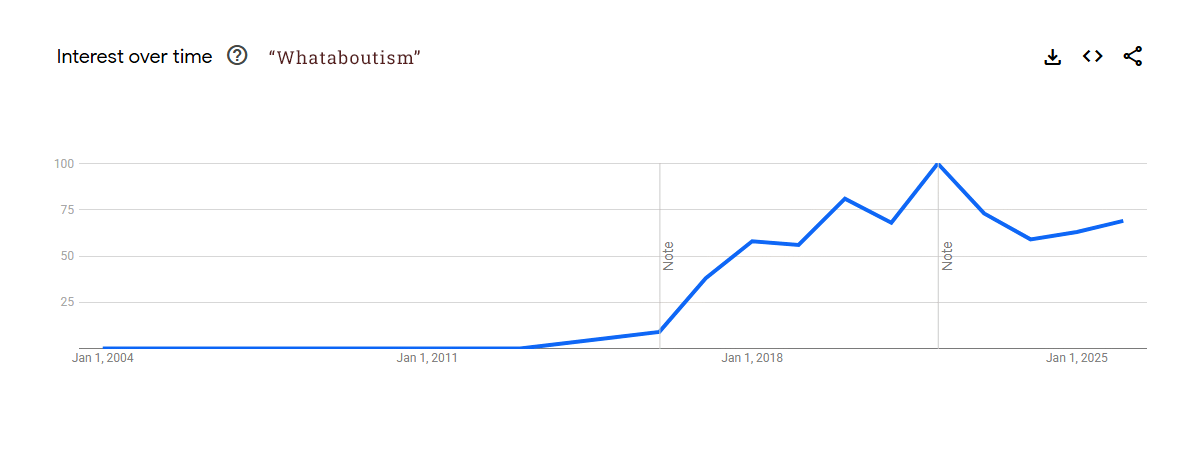
Etymology: Its modern use can be found beginning in the 1970’s, first as “whataboutery”. The concept, however, can be traced back to the Sophists of pre-Socratic ancient-Greece (4th - 5th centuries BCE)
☝️ Back to Whataboutism 👆
Tu Quoque
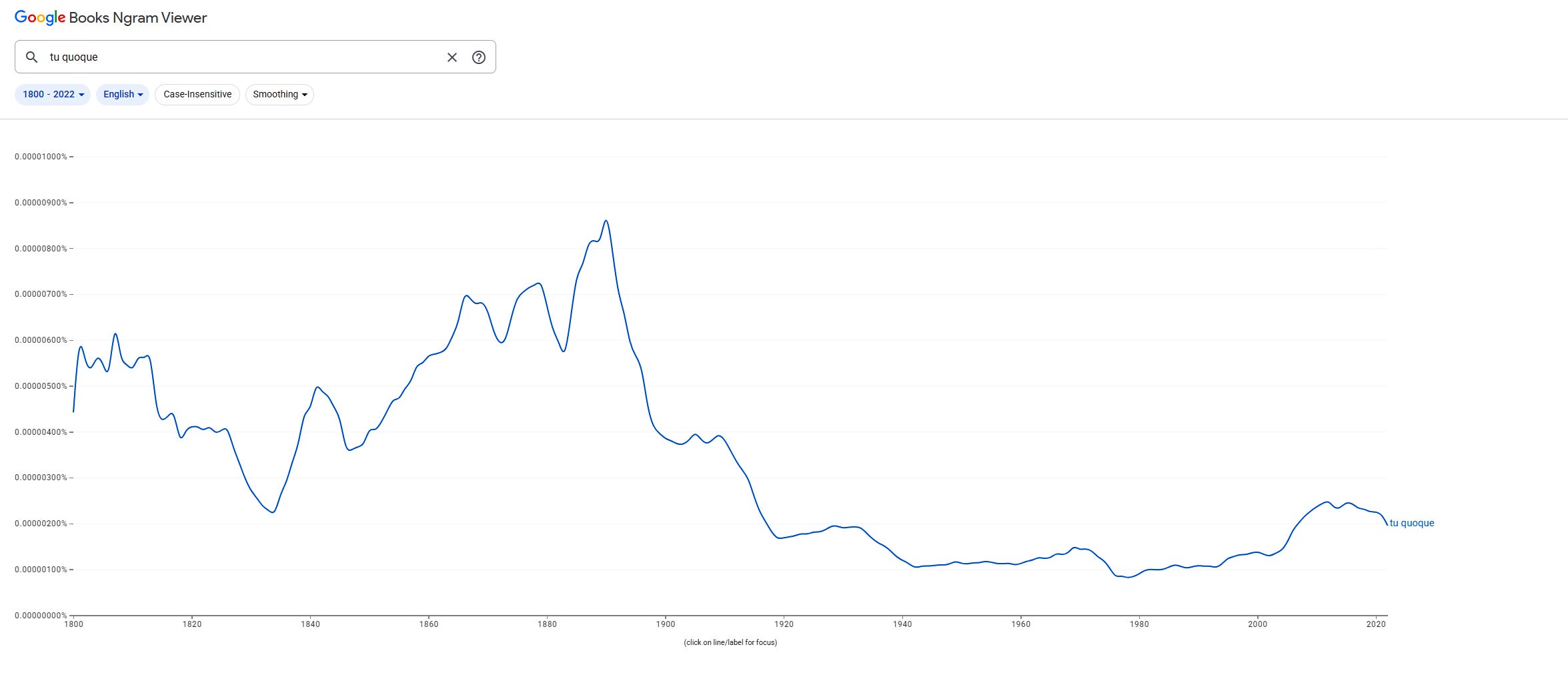
Etymology: Latin for “you too” or “you also.” The term entered English rhetorical usage in the early 17th century. Merriam-Webster dates its first known use to 1614.
☝️ Back to Tu Quoque 👆
Argumental Hermit Crab
Etymology: Coined by Steven of the Club for tAFM in 2026 after repeatedly watching arguments abandon one failed reason, skitter across the conversational beach, and crawl into another clammy claim-shell without lowering their confidence. Named for the shell-swapping little critters seen scuttling along the shore in full smugface.