
This page is part of The Argument Field Manual (tAFM)—a living field guide to bad reasoning, rhetorical tricks, semantic sludge, broken mental models, evidence games, loaded language, tribal cognition, and other machinery that makes public thinking stupid.
TAFM → The Move → Defensive Moves → Defensive Retreats
This page contains a closely related family of concepts, fallacies, and argument manoeuvres. Use it to identify what you’re seeing in the wild, understand what the move is doing, and choose a repair strategy before it eats the conversation.
These moves do not answer pressure. They relocate away from it. When the argument becomes costly, the speaker retreats to a safer version, a narrower definition, a higher standard, a special exception, or a claim no one can test.
Table of Contents \ Defensive Retreats
Motte-and-Bailey \ advancing a bold claim, then retreating to a safer one.
Goalpost Moving \ Changing the standard after it is met.
Schrödinger’s Joke \ When a position becomes a superposition.
• Motte-and-Bailey
A motte-and-bailey is advancing a bold claim, then retreating to a safer version when challenged.
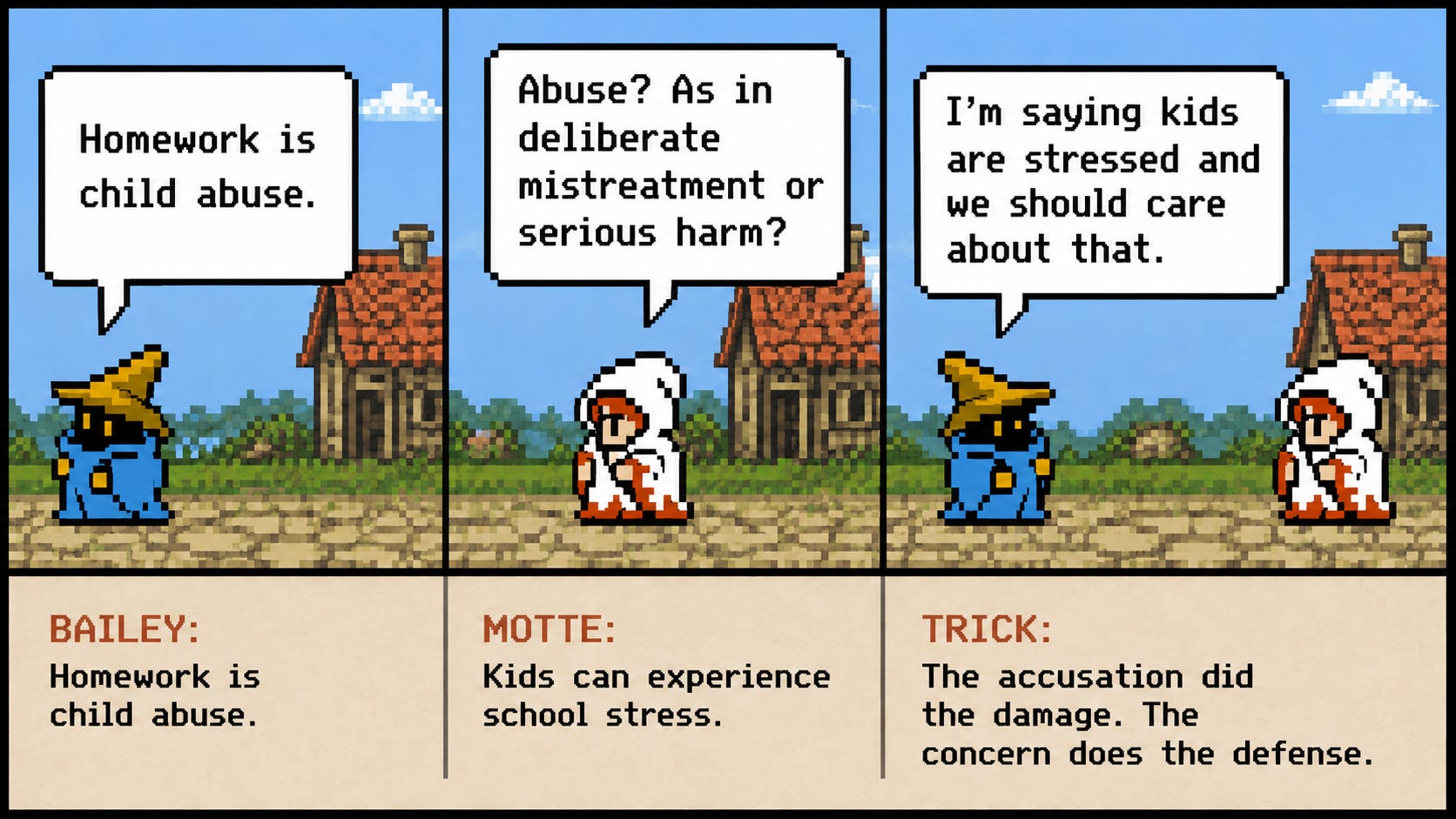
What’s happening here?
The person advances a bold, aggressive, territory-grabbing claim. When challenged, they retreat to a safer, weaker, more defensible claim. Then, once the danger passes, the bold version mysteriously reappears wearing fresh lipstick and pretending nothing happened.
The bailey gets the applause.
The motte gets the defense.⠀
⠀
You’ll recognize this when…
The claim changes altitude under pressure. The first version sounds dramatic, expansive, and consequential. The defended version sounds obvious enough that disagreeing with it makes you look like you eat crayons recreationally.
The move depends on treating the safe version as if it proves the bold version.
⠀
Why it matters:
Motte-and-bailey arguments let bad claims borrow the credibility of good ones. They expand aggressively, defend modestly, and then expand again once everyone gets tired.
This makes debates slippery. You think you are challenging “X is violence,” and suddenly you are being asked why you deny that words have effects. Nice little claim you had there. Shame if someone replaced it mid-sentence.
⠀
Related concepts:
Motte Retreat, Definition Retreat, Strategic Vagueness, Claim Compression Check, Standard Check
⠀
Common disguise:
“That’s obviously what I meant.”
⠀
Common escalation:
The retreat is treated as clarification, and your objection to the original claim is treated as hysteria.
⠀
Repair move:
Ask: “Which claim are we evaluating: the bold one you used, or the safe one you are defending now?”
☝️ Up to TOC 👆
• Goalpost Moving
Goalpost moving is changing the required standard after the previous standard has been met.
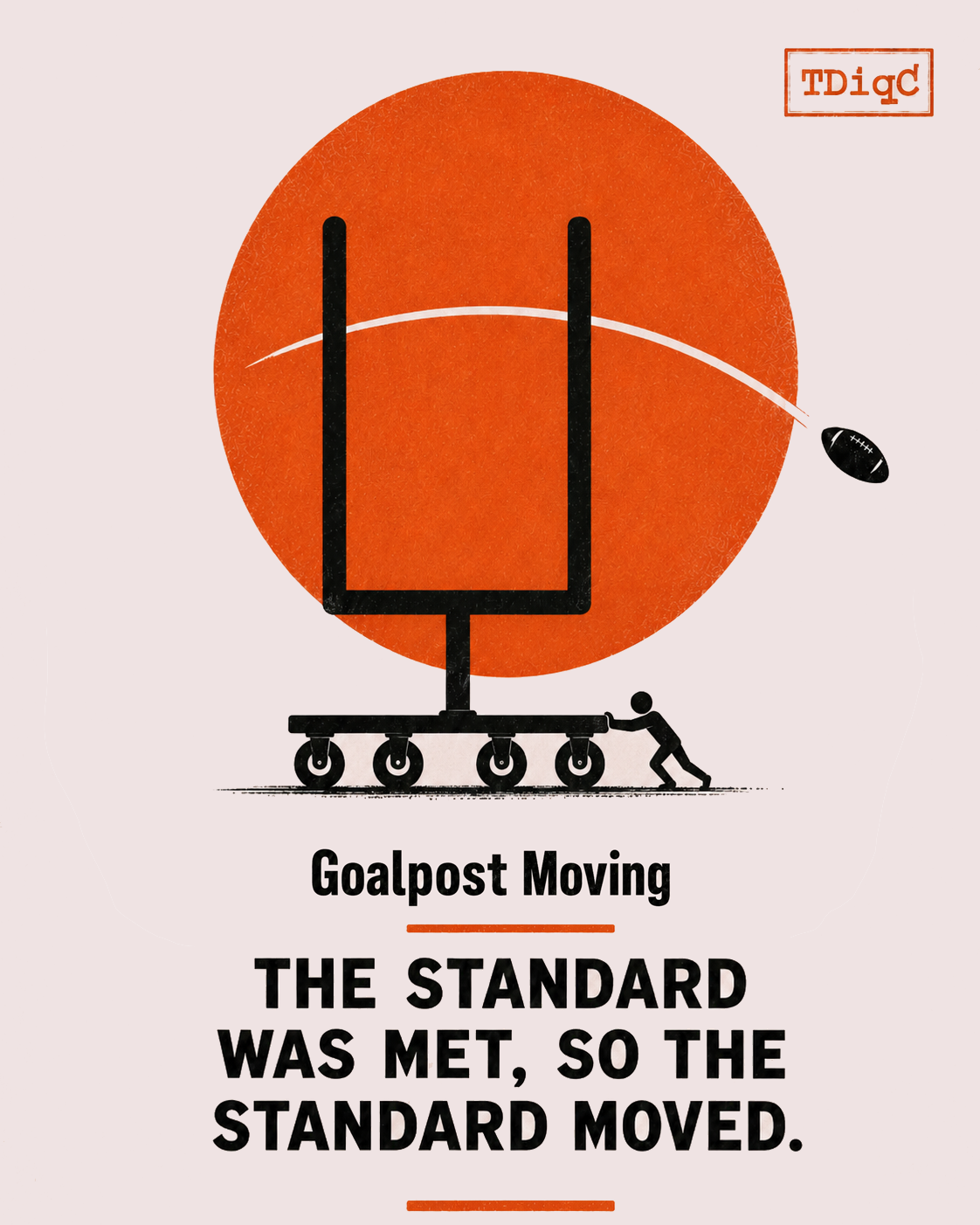
What’s happening here?
The standard was met, so the standard moved. The person asked for one thing, received it, then quietly upgraded the demand because the original demand was only useful while unmet.
This is argument Calvinball. The rules are never the same twice, and they always become whatever prevents the other person from scoring.
You’ll recognize this when…
A person keeps saying “that’s not enough” without defining what enough would be before the evidence appears.
The demand becomes more specific, more extreme, or more impossible each time the critic satisfies the last version.
Why it matters:
Goalpost moving turns honest debate into a treadmill. You can run perfectly and still go nowhere because the other person controls the scenery.
The practical cost is exhaustion. People stop presenting evidence not because the evidence is weak, but because every answer generates a new entrance fee.
Related concepts:
Demand Inflation, Infinite Skepticism, Standard Check, Burden Placement, Proof-Obligation Reset
Common disguise:
“I’m just asking for better evidence.”
Common escalation:
The new standard becomes so total that no normal claim could survive it.
Repair move:
“Name the standard before I answer. What would count as enough?”
☝️ Up to TOC 👆
• Schrödinger’s Joke
Schrödinger’s Joke is retreat move where a claim, accusation, or implication is held to while it works, then becomes “just a joke” when someone tries to inspect it.
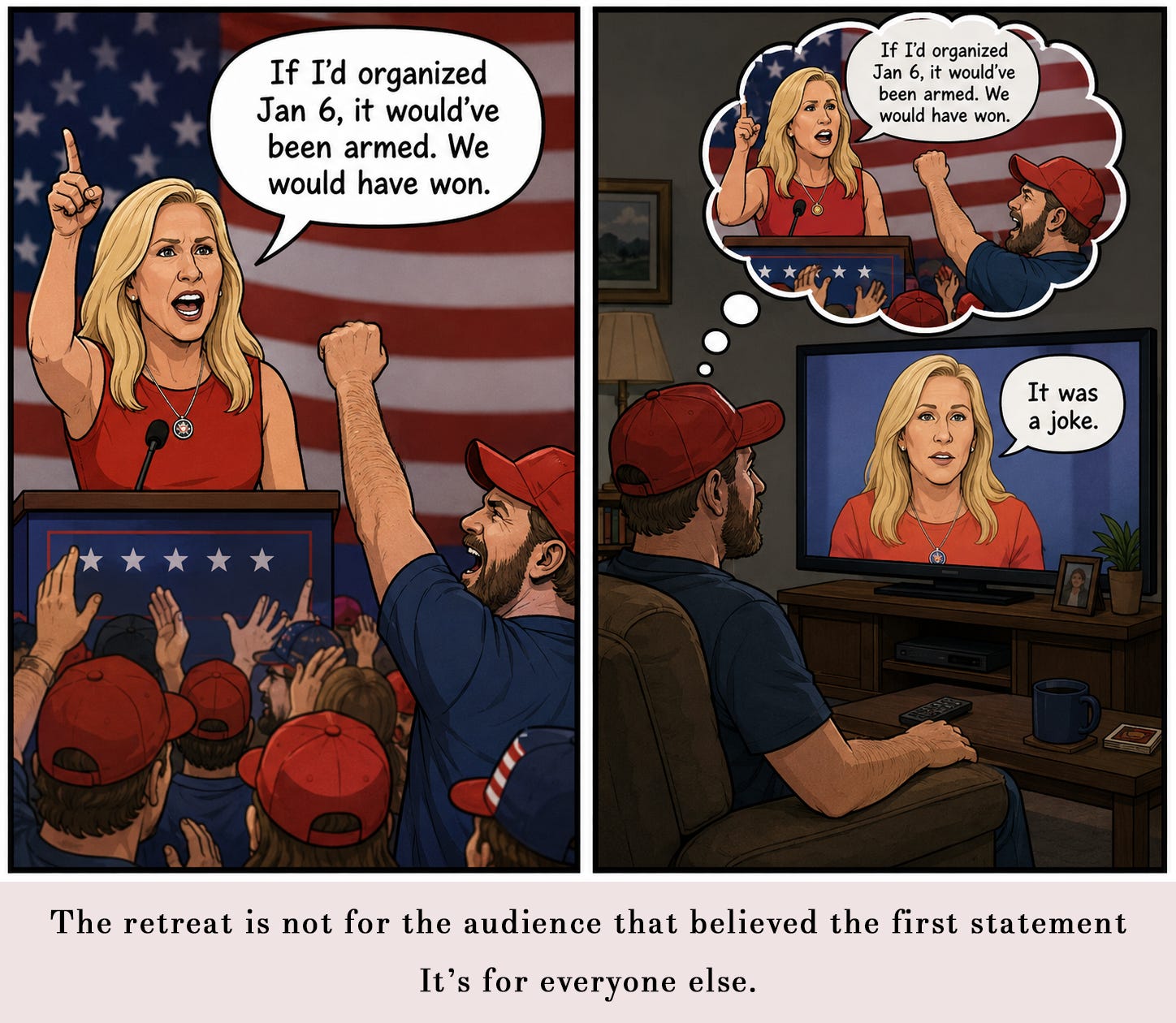
When someone’s position becomes a superposition:
The joke is doing argumentative work until someone tries to inspect it, and then it collapses into one or the other—whichever favours the joker.
Schrödinger’s Joke:
Frames the critique.
Implies a motive.
Pushes a political interpretation into the room.
Once challenged, the implication suddenly becomes weightless: not a claim, not an accusation, not a frame — it was just a joke.
That is the retreat.
The joker wants the joke treated as meaningful when it lands, but unserious when it costs something.
Schrödinger’s cat existed in both states — dead and alive — until someone opened the box and resolved the two states into one.
Here, the joke is both “a real point” and “obviously not serious”. Audience reaction, or social blowback, decides which version appears when the box is opened.
If the room likes it,
⠀it was a sharp observation.
If someone objects,
⠀it was comedy,
⠀and the objector is now on trial for failing to laugh correctly.
The claim becomes whatever costs less after the box opens.
You’ll recognize this when…
The joker wants the benefit of the implication without the burden of defending it.
The joke has a clear target, accusation, frame, or political meaning—right up until someone asks whether that meaning is actually being claimed.
Then the conversation shifts from:
“Is that claim true?”
to:
“Why are you so weird about jokes?”
The original claim walks out the back door. The critic gets dragged into a tiny comedy tribunal where the charge is Failure to Laugh Correctly.
Why it matters:
Schrödinger’s Joke turns humour into a one-way valve.
Meaning goes out.
Responsibility does not come back in.
This matters because jokes can absolutely make claims.
They can
present patterns,
compress criticism,
reveal rationalizations,
puncture pomposity,
and make facts felt faster than abstract arguments can.
Jokes are powerful because they can move meaning faster than argument. A joke is not exempt from communication just because it is funny. The question is not only what the words literally said. The question is what the joke made available to believe.
Smuggling a secret, even hostile, meaning inside a joke gives the joker several social advantages of comedy:
delivery, charm, deniability, group laughter, and pressure on anyone who objects. The person challenging the claim can then be made to look like the problem—not because they misunderstood the joke, but because they understood it clearly enough to ask what it was doing.
The two-audience trick:
Schrödinger’s Joke often speaks to two audiences at once.
To critics, the retreat says: you cannot prove I meant it.
To supporters, the retreat says: you and I both know I meant enough of it.
That is why “I was joking” does not always erase the original message.
Sometimes it protects the joker from outsiders while strengthening the bond with insiders.
The critic hears a denial,
The fan hears a wink.
The joke keeps traveling after the official meaning has been recalled.
What this isn’t:
This is not every edgy joke, every failed joke, or every instance of sarcasm. Any of those can become a Schrödinger’s Joke, but only when the joker uses “just joking” to protect a claim-like meaning from inspection.
A joke can be offensive without being a Schrödinger’s Joke.
A joke can make a point without being evasive.
A joke can land badly without becoming a retreat move.
The diagnostic question is not:
“Did someone dislike the joke?”
The diagnostic question is:
Was the joke allowed to imply a claim, then protected from inspection by pretending it was never claim-like at all?
Variants:
Claim-smuggling joke:
The joker floats an unpopular, aggressive, or socially risky claim as humour. If the room accepts it, the claim gets to live. If the room rejects it, they retreat into “obviously joking”.
Schrödinger’s Douchebag:
The troll variant. Here the point is not just to smuggle the claim. The point is to provoke a reaction, then turn that reaction into the punchline. The target becomes “too sensitive”, “triggered”, “hysterical”, or “unable to take a joke”.
The difference is usually functional more than provable. You do not need to mind-read the joker’s soul. Watch what the move is doing.
One version uses the joke as a shield.
The other uses the joke as bait.
Common disguise:
“Relax, it was a joke”
“Wow, people really can’t handle satire anymore”
“I didn’t realize I needed to put /s after everything”
“You’re proving the joke right”
Common escalation:
The retreat becomes an accusation.
Instead of defending the implied claim, the joker attacks the person who noticed it. The issue is no longer what the joke said. The issue is whether the critic is uptight, censorious, fragile, politically correct, humourless, or secretly guilty.
The joke goes into witness protection.
The joker puts on a robe.
The critic goes on trial.
The Joke-Meaning Test:
“Just joking” is not the end of inspection.
It is the start of translation.
Ask:
What did the joke require the audience to understand?
What belief, accusation, or frame made it funny?
If it was sarcasm, what was the opposite meaning?
Does that opposite meaning actually fit the context?
If the joke only works by smuggling the claim it later denies, that’s the retreat.
Repair move:
The joker’s move is to hide the claim inside the joke. The repair move is to analyze the joke without letting “it was a joke” end the inspection.
Analyzed jokes lose their humour, but that is not a defect here. Not every message carried by a joke was meant only for entertainment.
“Fine, it was a joke. What was the joke saying?”
Then press the translation:
“What did the joke invite people who ‘got it’ to believe?”
In many cases, that question cannot be honestly answered without revealing the claim they were trying to keep deniable.
Related concepts:
Irony Shield, Moving into Metaphor, Motte-and-Bailey, Bad-Faith Accusation, Mind-Reading Attack, Plain-Claim Translation, Claim Compression Check.
☝️ Up to TOC 👆
