

A stupid-sounding mind-tool that becomes alarmingly useful once it gets into your head
“Gooey prickles and prickly goo” may sound like rank nonsense.
But it is not…nonsense…..it is sense!
Or maybe it is nonsense.
But even nonsense can enter your head as a joke…and start reorganizing how you see things.
With this conceptual-linguistic mind-tool installed, you start noticing it everywhere: in arguments, identity, politics, science, language, intelligence, personality, species, systems, and every other place humans try to draw hard lines through moving reality.
That is why I like it.
Not just because it’s funny.
Because it names a thing a mind—that is paying attention—can notice:
The same reality can turn from prickle to goo, or goo to prickle, depending on the resolution you’re using to look at it.
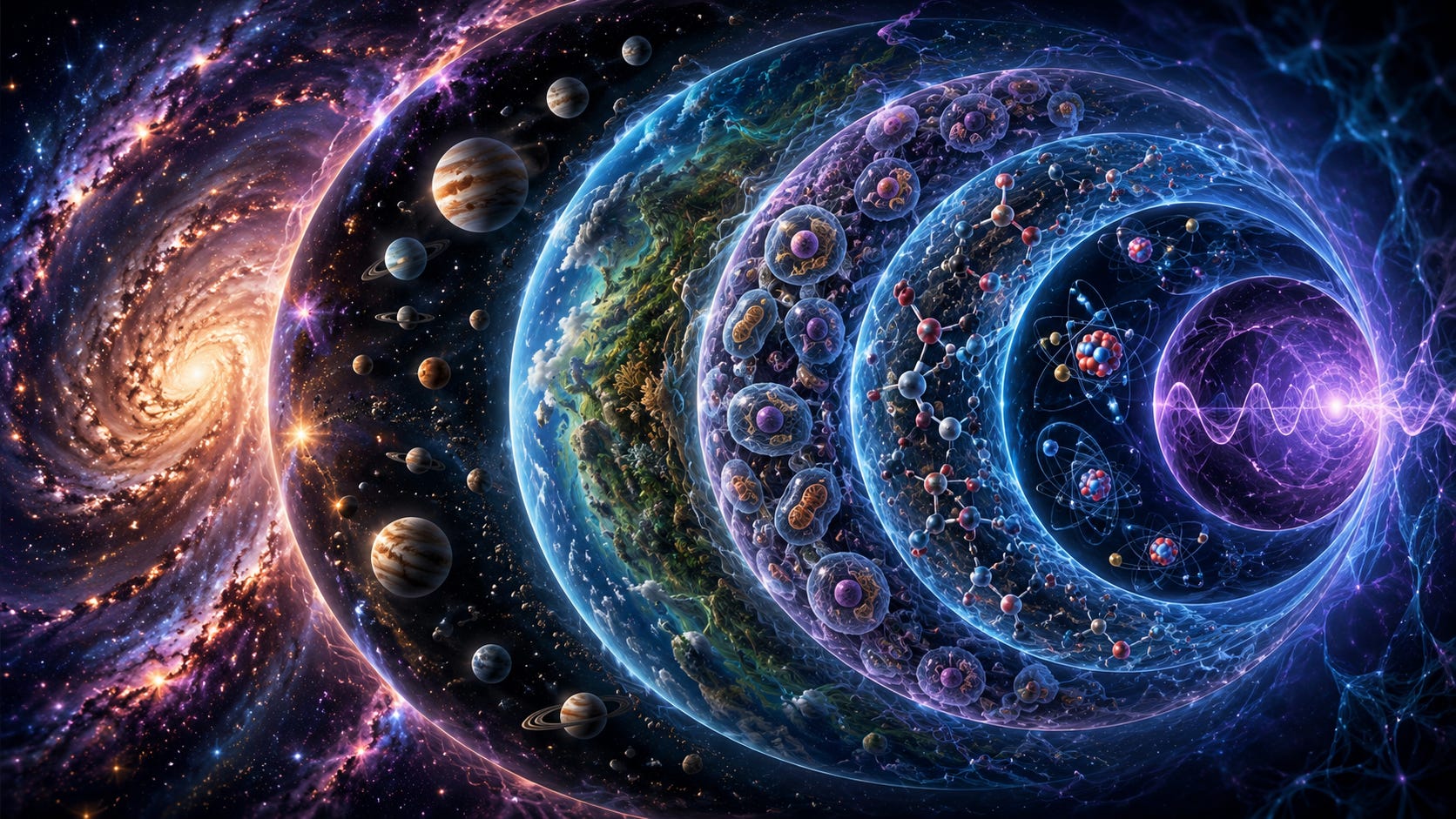
The fight as old as clubs and loincloth
Here’s a question humans have been getting into bar-fights over since we first started pointing at things and grunting nouns at them:
Is reality made of things?
Or is reality made of processes?
⠀
Is reality prickly?
Is it made up of a bunch of separate objects, hard edges, named units, countable marbles?
Or is it gooey?
Is reality made of fields, flows, gradients, continuums, relationships, fuzz, motion, process, soup?
Is Earth marble?
or
Is Earth soup?
The correct answer is, as is often true, annoying.
The answer is Yes.
Additionally, the answer is No.
Also, stop asking the question like that.
Reality is not simply a load of prickles or piles of goos. Our understanding of whether something is prickly or gooey depends on the resolution we’re looking at it at.
It depends on where we draw the boundary.
⠀
The universe: the supreme prickle
From one level of resolution, the universe is one thing.
One big prickle.
The universe.
A thing.
There it is. We named it. You could hold it in your hand, provided you have a sufficiently large hand.
But change the lens, and the one thing stops looking like one thing. It becomes galaxies, stars, planets, dust, radiation, gravity, dark matter, CME microwave background leftovers, and whatever else the universe has hiding between God’s couch cushions.
And all of this — known and unknown — is threaded through an incomprehensibly vast web of filaments, like strands of spider silk made of strings of galaxies.
Think you can hold that in your hand?
With or without your sufficiently large one?
Have you ever tried to grasp a spider web in your fist?
If you have, you’d make a terrible real-estate agent for the arachnid community.
Our single prick of a universe is also, when you refocus on its insides, a soup of gooey cosmos.
A universe-sized smear of interacting stuff.
Too much relation, motion, and scale to hold as a simple object.
⠀
The Sun: death-orb, tomato-engine, prickle
Then a star becomes a thing.
Our Sun.
One prickle.
Big yellow DNA smasher. Superman-food. Our perpetually exploding radiation explosion. A lovely floating nuclear furnace that gives us tomatoes and skin cancer.
At one resolution, “the Sun” is a perfectly sensible object.
You can look at it.
Not for long, sure, but you can look.
There it is: the Sun.
A thing.
But change the lens again, and the Sun stops being the whole subject.
It becomes the central region of mass and forces inside a much larger goo.
The solar system. What I thought, as an amateur child-physicist, was the answer to the question: “what would happen if a galaxy and an atom had a baby?”
So now, the relevant reality is not just “the Sun,” but orbits, gravity wells, radiation pressure, planets dragging moons around, tides, asteroid paths, orbital resonances, impacts, dust, billions of rocks, and trillions of frozen snowballs.
Throw in the internal forces, fields, and overlapping warpings of spacetime from every object of mass in the system, and “the Sun” is no longer the right-sized answer.
You need the whole gravitational and electromagneticalal mess.
“The Sun” is still real.
But if the question is about the solar system, a magnifying glass made to study sunspots is the wrong-sized tool to get the right-sized answer.
Sometimes the prickle is real, but the system it sits inside is the thing you actually need to understand.
The Sun is a prickle.
The solar system is goo.
Same reality. Different resolution.
⠀
Earth: marble, soup, wet argument-rock
And then there’s the Earth.
Another prick.
Our planet. Our blue marble. Our giant wet space-rock covered in all manner of life…loving and eating each other. Usually as separate events—but disturbingly, not exclusively.
Home of the humans — themselves a different layer of Earth’s prickles.
Zoom in.
Refocus.
Train the lens around Earth and the prickle dissolves into atmosphere, oceans, tectonic plates, bacteria, weather systems, borders, languages, supply chains, arguments, forests, fungi, mating rituals, and comment sections.
Goo.
⠀
People: Prickle Peter picked a peck of peppered pickle prickles
Back to our people-prickles.
Rob’s a prickle.
Becky’s a prickle.
Even Santa’s a prickle. Real or not, he’s a concept (as we all are to each other)—and so a discrete, definable, sensible prickle.
The three of them are absolute units. We all are:
One body.
One name.
One legal identity.
One set of two kidneys (or one lonely one).
But what happens when you crack open a human?
⚠️ Warning: Do not crack humans open unless properly certified, insured, and licensed by the state.
Inside a human, there lies a cornucopia of organs, fluids, cells, connecty-bits, bacteria, electrical impulses, memories, moods, childhood, caffeine, hormones, trauma, language, blood sugar, social incentives, and a hundred thousand little systems all pretending to be one coherent “I.”
Our prickly humans have become gooey again.
Goo made up of systems of prickles.
Cells: prickles.
Molecules: prickles.
Atoms: very satisfying prickles. Like little billiard balls. Tiny solar systems as seen in textbooks, chemistry posters, and felt in vibes.
But atoms betray us.
They stop being tiny marbles. They become fields, probabilities, distributions, charges, excitations, uncertainties — a subatomic haze of:
“It’s right there. Well, sort of… it depends on what you mean by ‘where’.”
Goo again.
⠀
The trick is the lens
That is the trick: not choosing goo or prickles, but noticing the lens.
The same reality can become thing-like or process-like depending on the resolution you are using to look at it.
That is why the phrase works. It gives the mind a handle for the moment when the thing you were holding as an object suddenly turns into a process — or the process you were drowning in suddenly resolves into something you can point at.
Alan Watts said it better:
Watts said this more playfully than I ever could. This video, made by South Park creators Trey Parker and Matt Stone, somehow made it look exactly as stupidly-coherent and absurdly-brilliant as it deserves to look.
Both little monsters are true.
The mistake is assuming the resolution you are using can describe a thing at every level.
A resolution may contain an entire slice of a universe with its own rules—rules that are nonsensical at another resolution.
Gravity “doesn’t exist” for microbes—surface tension and viscosity run the room.
From the perspective of a human, water is something you swim through.
From the perspective of insects, water is a skin you walk on, or a hard ceiling of surface tension that keeps you underwater.At least until you see a praying mantis in a black robe carrying a tiny scythe walk up on the other side of the water skin and look at you through the membrane.
A table is “solid.” But you don’t actually touch atoms in the sloppy billiard-ball sense of touch: tiny hard things knocking their dense little nuclei together. That’s “touch” as we tend to imagine it at everyday scales.
However, at the atomic scale, what actually happens is your atoms’ electron fields interact with the electron fields of the atoms that make up other objects. Even laying your hand against a wall, your nuclei never get closer than tens-of-thousands of nucleus-widths away from the nuclei of the wall’s atoms.
If your arm was thin enough (impossibly, infinitely thin) you could easily punch through a wall without touching it. If the wall was 5-inch-thick steel, about half of your punches through it wouldn’t touch a single atom of the wall.
(Presuming we suspend a few more tiny laws of physics)
⠀
The boundary is not fake
A prickle is what reality looks like when the human mind has drawn a useful boundary around some part of the world.
Goo is what reality looks like before, beneath, between, beyond, or overflowing the boundary.
That does not mean the boundary is fake.
It means the boundary is functional.
A chair is not fake because, at another level of resolution, it is atoms, and at another level of resolution, mostly empty space — and only at one useful human level of resolution, an object that makes sitting anatomically legible.
It is the difference between:
“Take a seat, so we can chat a while.”
and:
“Align the various interlaced matrices of matrices making up the outer fabric of material you’re wearing with the horizontal plane of the molecule matrix of that chair and come to a form of kinetic stasis with it, so we can chat a while.”
A chair is real enough.
But “real enough” is doing a lot of work there.
That is the useful part.
A thing does not need to be ultimate to be real enough.
A boundary does not need to be eternal to be useful.
A name does not need to capture the whole of reality to help us move through one layer of it without falling on our face.
⠀
Why this matters
Without boundaries, we die.
If you cannot determine:
This thing belongs in the bucket I have named “yummy berry”.
This thing belongs in the bucket I have named “hungry-looking wolf”.
Then your philosophical commitment to the gooey-continuity of nature will be admired briefly by the wolf.
Life requires us to draw lines. Make buckets. Categorize reality.
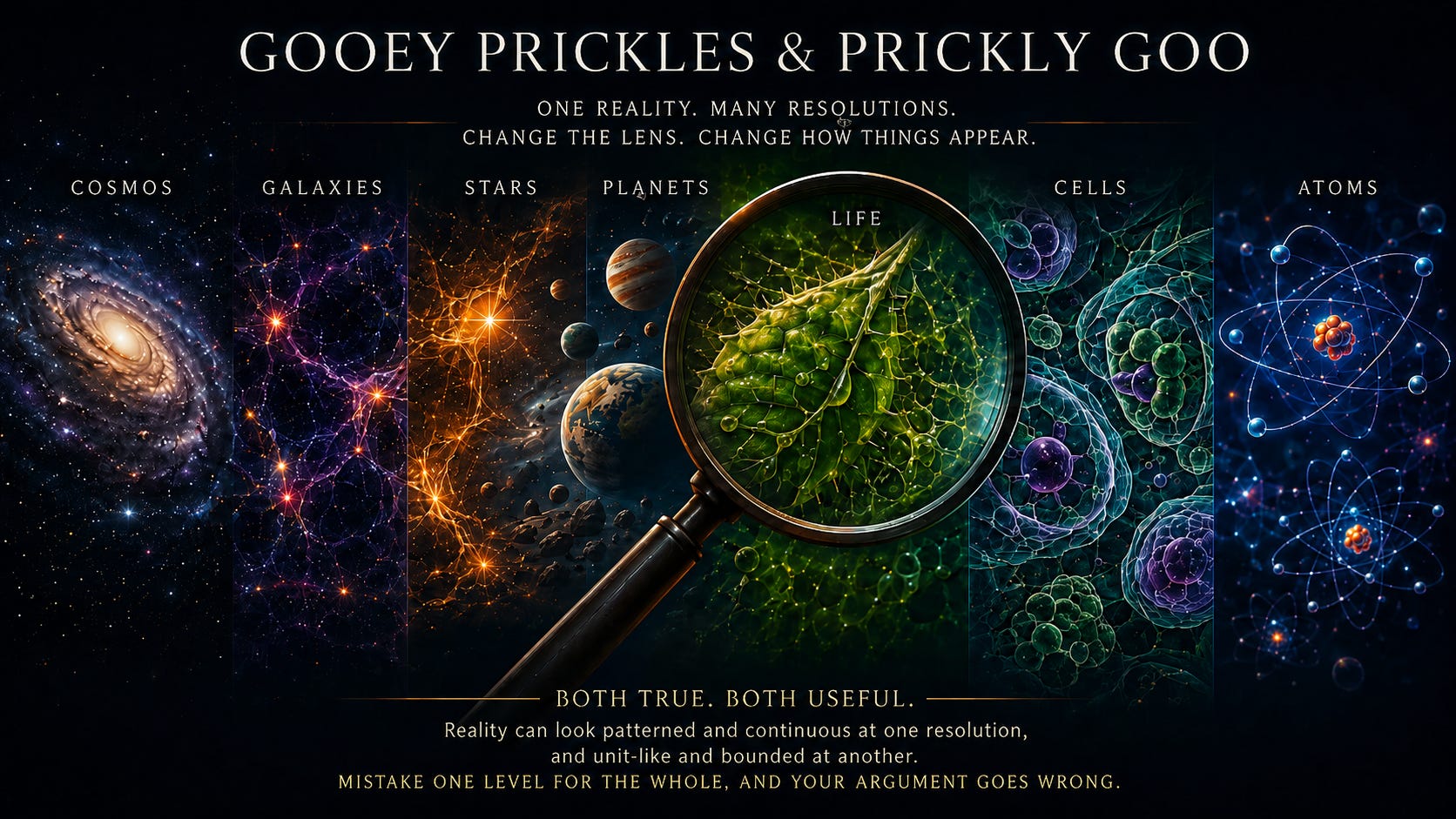
Food. Danger. Friend. Enemy. Tool. Person. Dog. Debt. Fire. Mine. Yours. Poison. Medicine. Machiavellian. Canadian.
These lines let the brain move through the world without recomputing existence from first principles every time something enters the visual field.
If every object required full metaphysical analysis before action, you would still be standing in your kitchen trying to decide whether the spoon is truly a spoon or merely a culturally reinforced scoop-prickle imposed upon metallic utensil-goo.
Eventually you would starve.
So no, boundaries are not the problem.
The problem is forgetting that boundaries are drawn.
That is where arguments go bad.
Someone points at a fuzzy pattern and speaks as if they have identified a hard edge.
Someone points at a statistical tendency and treats it like an essence.
Someone points at a social label and treats it like a biological species.
Someone points at a biological pattern and pretends it has no social meaning.
Someone points at a political camp and talks as if millions of people — internally divided, contradictory, confused, half-informed, emotionally motivated, and badly caffeinated — are one creature with one brain and one evil plan.
That is not thinking.
That is looking with the wrong resolution setting.
Argument Resolution Error:
Treating one valid level of description as if it were the whole reality.
⠀
When one resolution rules them all
Sometimes treating something as a prickle helps.
Sometimes treating it as goo helps.
Both can be employed to analyze the same thing, depending on what you’re trying to understand.
This distinction matters because:
Once one resolution of understanding becomes familiar (then comfortable (then habitual)), people may stop checking whether it still fits the thing they are looking at.
They stop asking what becomes visible at another scale.
They stop asking what disappears when the thing is treated as solid.
They stop asking whether the “thing” they are pointing at is actually a gradient, a cluster, a process, a relationship, a temporary pattern, or a moving system that only looks object-like from one angle.
And once that happens, language stops being a tool for understanding reality and becomes a tool for pinning reality down while it struggles.
This is where a lot of public argument lives now.
Not in disagreement over evidence.
That would be intellectually luxurious.
⠀
A great deal of modern argument happens one layer earlier:
People are using different resolution settings and pretending they are looking at the same object.
One person says:
“This is clearly a thing.”
The other says:
“No, it’s obviously a process.”
The first says:
“You deny reality.”
The second says:
“You worship labels.”
Then both sides spend three days clubbing each other with nouns while the goo leaks quietly through the floorboards, taking the prickles with them.
When the terms of an argument suddenly stop fitting the thing being argued about, you may not be losing the thread.
There may have just been a change in resolution.
Ask yourself whether the conversation has crossed from gooey prickles or prickly goo, into prickly goo or gooey prickles.
Illustrative examples — (simulated thought-bubbles):
“Wait — we started by talking about one bad law. Now we’re arguing about whether the entire political movement behind it is evil, stupid, corrupt, or secretly controlled by lizard accountants.”
“Well sure… at the task level, she made a mistake. At the workflow level, the system was designed to produce that mistake eventually.”
“Hold on. If we treat this as one sentence, it sounds harmless. If we treat it as one instance in a repeated pattern, the thing changes shape.”
“Hey — they’re only talking about the proposed policy’s claims and refusing to acknowledge the knock-on effects that implementing it will have on incentives, enforcement, courts, budgets, voters, agencies.”
⠀
Check the resolution
The useful move is to ask what level of description you’re standing on.
At what resolution is this a thing?
At what resolution does it become a process?
At what resolution does that process become made of things again?
That is the tool.
Not “everything is complicated,” which is usually just intellectual fog machine behaviour.
Not “nothing is real,” which is just metaphysics having a lazy day.
Not even the great “common sense says…”, often said by people speaking in an entirely different layer of goo or prickles than you.
The tool is simpler:
Before arguing over whether something is or isn’t a thing, check the resolution.
The world is not obligated to fit the resolution setting of your argument.
Sometimes a thing is real at one scale…and misleading at another.
Sometimes an edge is sharp enough for practical use…and fuzzy enough to make every absolutist sound like an old man yelling at a cloud for its mist-ifying behaviour.
This should make us more careful.
Not paralyzed.
Careful.
Because humans need names. We need edges. We need stable, describable prickles. Drawing these boundaries helps us live life as an everyday human, because we cannot live in raw goo. We would drown in the detail.
But the world does not stop being gooey just because we drew a prickle around part of it.
The mind does not become wise by gripping the prickle harder.
The mind becomes useful when it remembers what a prickle is doing.
Reality gives us patterns.
We draw boundaries:
Sometimes the boundaries help.
Sometimes they fail.
Sometimes they change when the lens changes.
And sometimes, if you’re lucky, a joke sentence waddles in wearing cartoon spikes and goo’d-back hair and reminds you that the world is not made at one resolution.
So before you argue over what something is, check to make sure you’re both thinking about the subject at the same resolution.

⠀Supertomato believes in you
⠀
Bonus Content for Paid Subscribers
The article above is complete.
Below is a little extra content to say thanks to my paid subscribers.
